How the BAMI-I scholarship experience at UIS and UIC helped shape a more proactive approach to utility investigation, documentation, and BIM-informed practice
By Karen Ortega
The challenge of underground utility risk is not new, but its significance often becomes fully clear only through direct field experience. My perspective began with civil engineering practice in Colombia, where I developed a strong respect for field construction, practical decision-making, and the reality that many projects move forward with incomplete information. In road infrastructure work, crews often rely on experience, observation, and caution while still trying to keep production moving. That early foundation shaped how I understand construction today and taught me a lesson that has remained constant through later field engineering internships in Atlanta, survey work, and graduate studies in Construction Management Technology at Purdue University: plans matter, but field conditions have the final word, and the gap between what is documented, what is assumed, and what is actually present underground can define project risk.
Later, during my internships as a field engineer in road infrastructure in Atlanta, I experienced this reality at a much higher level of pressure, especially while working in an airport environment. Airport work is already complex because of safety, operations, access restrictions, and schedule demands. But one of the biggest challenges was underground utilities. Not all utilities were clearly located, and in some areas the information available to us was limited or intentionally restricted for valid reasons related to security and operational sensitivity.
In practice, this meant we were often working very carefully, very slowly, and with constant tension. It felt like working with our eyes partially closed, doing everything possible to avoid a strike while knowing that the consequences of hitting something underground could be severe. On that project, despite our efforts, we hit utilities twice. Even when the direct impacts on money and time were not always as catastrophic as people might assume, the incidents triggered a much larger chain of concerns: safety alarms, operational concerns, internal escalation, and even public attention and news alerts. In an airport, utility damage is never just a field issue. It can quickly become a public issue.
That experience stayed with me. It made me think more deeply about the gap between what we know in the office and what crews face in the field. I moved into the survey world, and that is where many things started to connect for me. Surveying taught me to see the project differently. I began to understand the rhythm between records, control, field verification, and constructability. I saw how survey can act as the link between documentation in the office and what becomes truly possible for crews in the field. Survey is not only about points and coordinates. It is about confidence, interpretation, and translating information into something that people can build from safely and efficiently.
That perspective became even more powerful when I started my master’s degree in Construction Management Technology at Purdue University, where I have focused on the use of technologies to manage projects. At Purdue, I have been especially interested in how BIM and digital workflows can support construction, not only for buildings but also for linear infrastructure projects. This is important to me because linear projects often move fast, cover long distances, and involve underground uncertainty across many changing conditions. In fast-tracked projects, we are expected to mobilize quickly, execute efficiently, and leave the site ready for the next phase, often while the underground conditions remain only partially known.
As I started developing my ideas around the use of BIM in these environments, I found myself returning to the same concerns I had in the field: utility uncertainty, incomplete records, risk exposure, and the disconnect between design information and actual conditions. I had many ideas, but I needed structure. I needed a framework. That is when I knocked on Dr. Iseley’s door.
Meeting Dr. Iseley was a turning point for me. He introduced me to a body of knowledge that was organized, practical, and directly connected to the questions I had been carrying from my field experience. Through his guidance, I learned more deeply about ASCE 38-22 and ASCE 75-22, and I immediately recognized how relevant they are to the concerns that have shaped my work. For me, this was not just academic knowledge. It was an answer to real problems I had already seen in practice.
Through BAMI-I, I was then offered a full scholarship to attend the Underground Infrastructure School (UIS) in San Antonio, Texas, along with the Underground Infrastructure Conference (UIC), which took place at the same convention center at the same time. I am sincerely grateful for that opportunity, because attending UIS and UIC at this stage of my professional development was exactly what I needed.
UIS was especially valuable because it gave me the chance to organize many concepts that had been living in my mind in a scattered way. I arrived with field experience, survey experience, and BIM interests, but UIS helped me connect them into a more complete system of thinking. It was not only about learning definitions or standards. It was about understanding the chain of processes, where the conventional process tends to fail, and what resources we actually have to improve outcomes.
One of the things I appreciated most about UIS was the people. We came from different backgrounds, but we were connected by the same need to understand and improve underground infrastructure practice. I found the group to be very open, engaged, and genuinely committed to learning. That made the experience even stronger, because the conversations in class, between sessions, and during activities helped reinforce the technical content in a practical way.
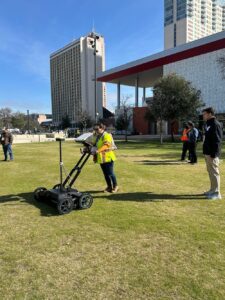
Another major strength of UIS was the hands-on component. Getting out of the convention center to investigate utilities ourselves helped create a full-circle learning experience. It was one thing to discuss utility engineering concepts in a classroom setting. It was another to apply observation, interpretation, and investigation thinking directly in the field. That combination made the lessons stick.
At the same time, attending UIC allowed me to expand beyond the classroom and see where the industry is heading. Between UIS sessions and class breaks, I was able to attend conference presentations, case studies, and exhibits. I found this to be an excellent way to learn because the presentations did not only show successful outcomes. They also discussed the challenges, limitations, and decisions involved in solving real problems. That kind of honesty is extremely valuable.
I also had the chance to explore the exhibits and speak with many industry partners and technology companies. Those conversations were important to me. They were not just company pitches. Many turned into meaningful one-on-one discussions about practice, expectations, innovation, and how we can realistically bring better workflows into the field. For someone like me, who is preparing to graduate and step into the industry full-time, this was the perfect place to connect technical learning with industry application.
UIS and UIC came at the right time in my life. I am close to graduation, and I am preparing to contribute at a high level in underground infrastructure work. These experiences helped me see more clearly how I can bring value to the industry and to the company I will work for: by helping move us away from the old mindset of “hit and fix” and toward a smarter approach based on investigation, documentation, coordination, and better use of available resources.
For me, the future is not only about locating utilities more accurately. It is also about becoming better producers of information ourselves. That includes improving as-builts, strengthening field-to-office communication, and applying core BIM concepts to underground infrastructure processes in ways that are practical and useful. If we combine utility investigation principles, proper standards, survey discipline, and BIM-based information management, we can reduce uncertainty and make underground work safer, more efficient, and more predictable.
I am grateful to BAMI-I for this opportunity, and especially grateful to Dr. Iseley for recognizing how meaningful UIS would be for my professional path. UIS and UIC did not just give me more information. They gave me clarity, structure, and direction. They showed me that what is underground does not have to remain a mystery, and that our industry already has the knowledge, tools, and people needed to do better. Now the responsibility is to apply it well.
About author
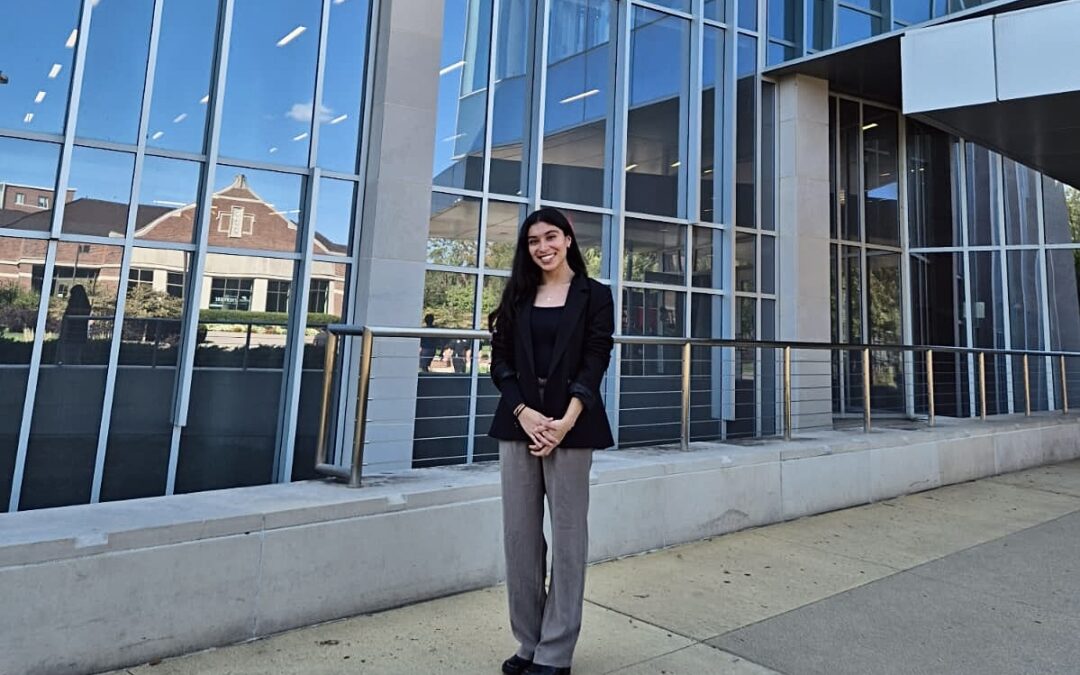
Karen Ortega is a civil engineer from Colombia and is graduating this summer with a master’s degree in Construction Management Technology from Purdue University. Her background includes road infrastructure, field engineering, surveying, and BIM, with a growing focus on underground utility investigation, linear infrastructure, and technology-driven project delivery.