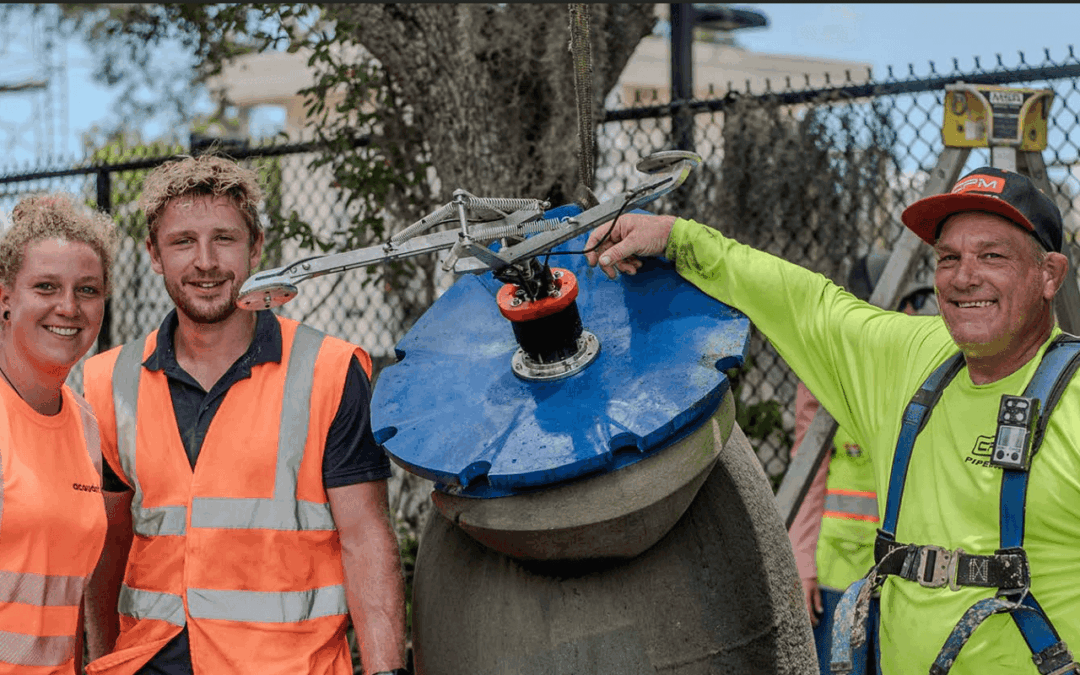
 In the ever-evolving field of pipeline maintenance and inspection, innovative technologies are leading the way. A recent significant project involved ultrasonic testing (UT) inspection of a 24-inch diameter wastewater force main in the U.S. The Acquarius, developed by Acquaint, is a UT-based inspection technology housed in a soft foam pig. Designed to traverse pipelines and gather comprehensive condition assessment data, this tool represents the cutting edge of inspection technology in the water/wastewater industry.
While the UT sensors are the headliner of the onboard technology, the tool includes other data collection devices such as a hydrophone for identifying leaks and gas pockets, as well as location tools to map the XYZ alignment with extreme accuracy. The results of the inspection provided invaluable insights into the structural integrity and overall health of the pipeline, ensuring its continued safe and efficient operation.
The pipeline in question, a 19,000-LF long, 24-inch diameter ductile iron force main pipeline, is a critical component of the city’s wastewater infrastructure. At the time of inspection, it had already experienced failures. A broken clock may still be right twice a day, but a broken wastewater pipe is wrong 24/7. Therefore, the line required a thorough inspection to evaluate its condition and identify and prevent future complications. The Acquarius was up to the task as a versatile and effective tool for navigating pipelines of varying sizes and conditions while gathering an abundance of condition data.
Days 1-2: Clean the Line, Walk the Line
Early in the execution of the project, the best understanding of the pipeline’s alignment is used to set preliminary markers at ground level every 300-ft or so. As you’ll read, these markings are critical and will eventually be fine-tuned to provide an extremely accurate location of the entire main.
The inspection process continues with a meticulous cleaning of the pipeline to ensure unobstructed passage for the foam pig and accurate data collection. The resolution of data provided from the sensors onboard the Acquarius is maximized when the ultrasonic waves make clear, unobstructed contact with the inner pipe wall. However, sending large cleaning pigs through any pipeline can be risky. It is an unavoidable truth that pigs can become stuck. In any pipeline, not to mention those having already experienced failures, more aggressive cleaning methods can also create or exacerbate issues and cause a failure. Therefore, the cleaning process always begins with the least intrusive, most nonaggressive approach – bare, soft foam pigs.
Soft foam pigs are an ideal starting point for pipeline cleaning for several reasons. First, they are extremely compressible and, while they can move debris out of the pipe perfectly well, they will also compress greatly to navigate unexpected reductions, harsh bends, or hard debris. Furthermore, they are easily destroyed. This may sound counterintuitive but when launching the first pig into a pipeline, one is at the mercy of accurate drawings and other record documents. There could be unknown changes to the pipeline where a pig can become stuck. Soft foam pigs can more easily dislodge, compress, or even shred apart when encountering such obstacles.
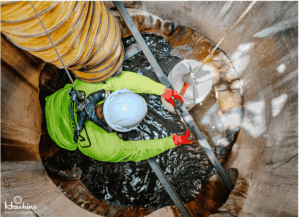 The first foam pig was launched, as with all subsequent cleaning pigs, from the force main lift station. Just outside the station, the owner installed a new wye fitting which allowed the inspection team to build upon it a launching assembly. In this case, the assembly consisted of a simple 24-in by 30-in reducer. The 24- to 25-in outside diameter cleaning pigs could easily fit into the 30-in side of the reducer and a 30-in blind flange was bolted on after the pig was inserted. The blind flange was modified to include a water intake port and a pressure gauge. After the pig was inserted and the flange bolted, water was pumped through a 6-inch centrifugal pump to build the necessary pressure to move the pigs through the wye and into the force main. All cleaning and inspection pigs are equipped with transmitters allowing them to be tracked from the surface. When the pigs are tracked through the wye and into the force main proper, the secondary pump is no longer needed, and the existing force main pumps push the pig through the remainder of the alignment. To aid in the tracking, which is done on foot with receiver units, the station pumps are dialed in to a flow velocity of roughly 1.5 feet-per-second. This is the target speed for the inspection pigs as well to optimize the wave pulses and maximize data quality. The velocity results in an approximate travel time of 3.5-hours, coupled with the setup and retrieval tasks, each pigging run took one workday.
The various pigs were collected at the bar screen of the downstream treatment facility (cleaning pigs) or the force main discharge manhole just upstream of the facility (proving and inspection pigs). As the foam pigs approach the retrieval point, the water is observed to visually determine how much debris, oil, grease, or other solids were dislodged during the run. When the soft foam pigs are retrieved, they are scrutinized for any evidence of issues along the main. This includes how clean the pigs are and if there are any gouges, rips, or other signs of damage that may pose a risk to further pigging. In the case of the 24-inch force main inspection, the first cleaning pig, while quite dirty, did not exhibit extremely worrisome damage. A second soft foam pig was launched through the pipeline and was in similarly good condition upon retrieval. The water ahead of the pig was relatively clean, as was the pig itself, and therefore the pipeline was deemed ready for the proving run after two days on-site.
Day 3: Proof in the Pudding
With the pipe sufficiently clean, the next step in the Acquarius inspection process is to launch what is called a proving pig. The proving pig is the same size,
weight, and has the same composition of soft and medium foam makeup as the Acquarius inspection pig. The difference? The proving pig does not contain the expensive sensor arrays and other technologies inside its hollow core. 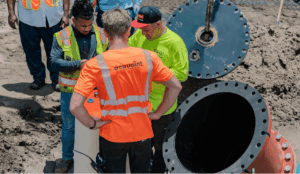 While it was confidently established that soft cleaning pigs could traverse the main without becoming lodged or damaged, the Acquarius is significantly longer and includes portions of medium density foam. As such, the proving pig (and thereby the Acquarius) are much less forgiving to bends and diameter changes. While all reasonable measures were taken to ensure the pipeline was free of obstruction, whether by debris, alignment, or diameter, the proving pig is a cautionary measure used to maximize the success rate of the Acquarius.
On the third day, aside from the creation of dry land, seas, and plants, the inspection team launched the proving pig. It was launched in the identical manner of the cleaning pigs before it (through the wye at the lift station) and took roughly the same 3.5 hours to reach the discharge manhole. Upon arrival, once again the pig was inspected for signs of damage or unusual wear, of which it had none.
Day 4: Subjection to Inspection
The previous three days of work, and weeks of planning, culminated in this event. The launch of the Acquarius UT smart pig. The line had been cleaned, an identical tool made it through the system unscathed, therefore the table was set. As the inspection process carried out, crowds grew with members of the city’s engineering department, operations group, local consultants, and seemingly anyone who wanted to see a cutting-edge pipeline inspection tool do its thing.
On a rainy, humid, morning, with biblical levels of mosquitos, the Acquarius was constructed. As sophisticated as the tool is, it’s assembly would seem relatively straightforward to an onlooker. However, taking a closer look to see the fine tuning, the modifications, measurements, calibration, re-measurements, and quality control, one can understand how so much data can be provided by the technology. When the inspection team was satisfied with the tool’s preparedness, there was only one thing left to do. The pig was loaded into the launch assembly, pumps activated, and off it went.
The Acquarius traveled the roughly 3.6-mile alignment cooly and calmly, tracked every foot of the way. The original alignment markings, one of the early steps in the process, are now adjusted to accurately represent the precise points of the main at ground level. The markings are included at every 300-feet and also at each bend. Who’s kidding who, though, the alignment data is great. Outstanding. A means of bolstering existing GIS data and more accurately mapping the main. However, there’s a treasure trove of data the Acquarius is collecting along its journey, and the team wants to open that chest.
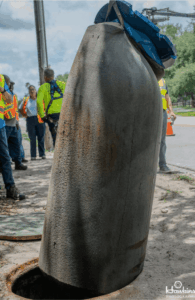
The Acquarius arrived at the discharge manhole with about 100 eyeballs staring at it. The onboard hydrophone may listen for leaks and air pockets, but it was most likely picking up the thunderous applause as it landed safely into the manhole channel. The vessel was pulled out of the manhole with a crane truck (as was now saturated with water, clocking in at around 450 pounds), and then…We wait.
The data logger is removed from the Acquarius, taken out of the field, and uploaded to Acquaint’s cloud for an initial quality check. This process involves a preliminary look into the quantity and resolution of the data – essentially verifying the quality of information across the entire alignment. As a precautionary measure, no personnel, equipment, piping, fittings, vehicles, or hoses leave the project site until the data quality is confirmed. While the odds of needing another inspection run are extremely low, it’s safer to keep everything in place until verification. Following the quality check, the data was reported as outstanding in both magnitude and quality, marking a successful completion of the inspection process.
This groundbreaking inspection of a critical force main exemplifies the successful collaboration between CPM Pipelines, Acquaint, and V&A Consulting Engineers. It demonstrates our shared commitment to providing asset owners with cutting-edge solutions that maintain vital pressure pipes, protect the environment, and serve communities.
Author: CPM Pipeline Team