Purdue’s WRF 5365 Project Gets Underway with Strong Industry Support
The Water Research Foundation (WRF) has awarded Project 5365 to Purdue University to develop the “State-of-Practice Manual for Inflow and Infiltration Detection and Mitigation at Street and Private Lateral Levels.” The project is underway, bringing together research, utility experience, and industry expertise to develop a practical Manual of Practice (MOP) for utilities and municipalities.
The Purdue research team is led by Principal Investigator Dr. Dulcy Abraham and Co-Principal Investigator Dr. Tom Iseley. The team also includes graduate research assistant Sihan Zhou and research engineer Wei Liao. BAMI-I’s technical network and buried asset management expertise also support the project.
As of September 9, 2026, the project has received support letters from 32 partners—30 organizations and two individual consultant. kickoff with WRF and its Project Advisory Committee (PAC) took place on August 17, followed by partner discussions on August 20 and 21. A preliminary literature synthesis and draft survey and interview questions provide a foundation for the next stage of research.
Building the foundation for a practical manual
Project preparation has included internal planning, a Quality Assurance Project Plan, communication procedures, and partner coordination. The work plan is organized into four connected phases: Investigation, Communication/Knowledge Exchange, Evaluation, and Validation. Surveys, interviews, workshops, and technical review will allow practitioner experience to inform the research throughout the project.
The preliminary literature synthesis covers technical guidance, research papers, utility reports, municipal procedures, and practitioner resources across four themes: detection and quantification, assessment, mitigation, and governance. Initial comparison tables address the spatial and temporal resolution of detection methods, corrective actions matched to confirmed I/I sources, and lateral responsibility boundaries. Together, these comparisons connect source identification with implementation and evaluation.
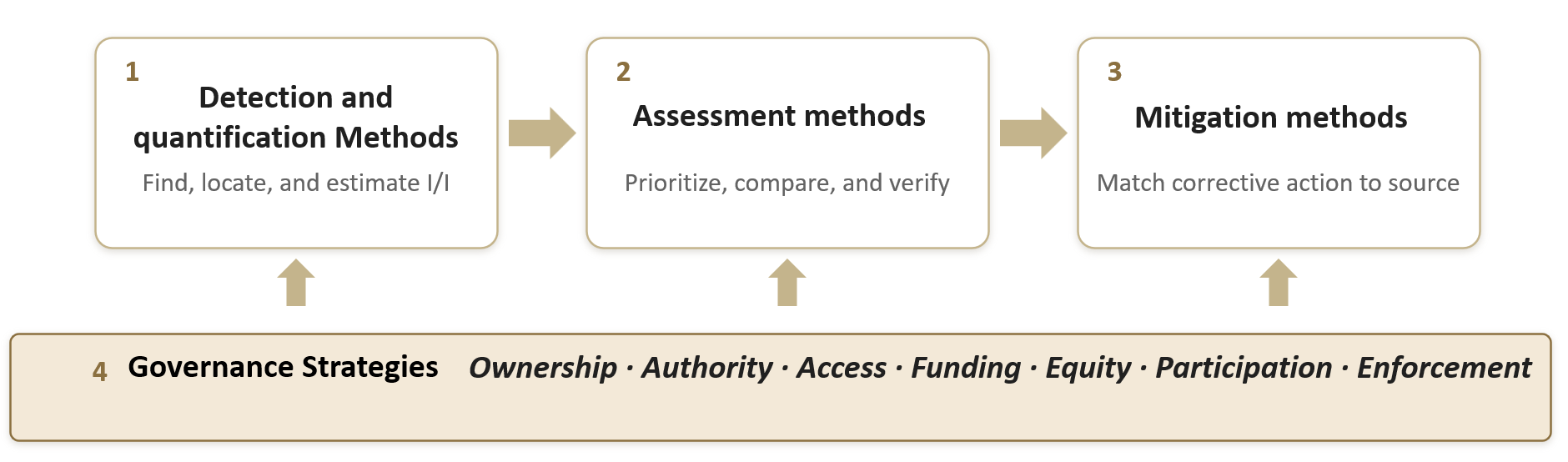
Figure 1. The project’s four-theme research framework. Governance supports detection and quantification, assessment, and mitigation.
Early project work highlights issues that need to be considered alongside technology selection: ownership, definitions of success, homeowner participation, and maintenance. The following insights are preliminary. Their purpose is to invite industry input and guide further investigation.
EARLY INSIGHTS FROM INDUSTRY COLLABORATION
Lateral ownership shapes program design and delivery
One issue receiving particular attention is how lateral ownership and responsibility boundaries shape an I/I program, well beyond who pays for repairs. These boundaries affect who can arrange inspections, coordinate corrective work, and maintain the asset afterward. The draft survey asks about ownership, access authority, payment, restoration, and long-term maintenance separately, so the team can see not only where a boundary is drawn but how utilities organize work across it.
Partner discussions have reinforced that lateral ownership and responsibility vary substantially among utilities. The team is examining how these differences affect inspection and testing requirements, right-of-entry arrangements, homeowner communication, incentives, enforcement, restoration, and long-term maintenance.
PAC discussions have added practical perspectives on responsibility for the work itself. Becky Specht of Milwaukee Metropolitan Sewerage District highlighted cases where a municipality works on a privately owned lateral but the homeowner later bears the consequences of poor restoration. Other utility experience has underscored the additional budget, staffing, and operational demands that can arise when responsibility extends toward the building. These perspectives reinforce the need to define restoration duties, work quality, resources, and ongoing obligations—not simply ownership.
Partner discussions have also highlighted cases in which work on mainlines and manholes alone could not address system-wide I/I, requiring utilities to consider private laterals as part of the solution. These examples will inform case-study review of the authority, access, funding, and implementation conditions needed to address sources on private assets.
The preliminary synthesis groups program approaches into incentive-based, enforcement-based, and utility-led models. It also distinguishes the reason for a program—such as capacity needs or regulatory compliance—from the mechanism used to carry it out. The aim is to understand the implementation conditions, not to assume that one ownership model or policy mechanism suits every community.
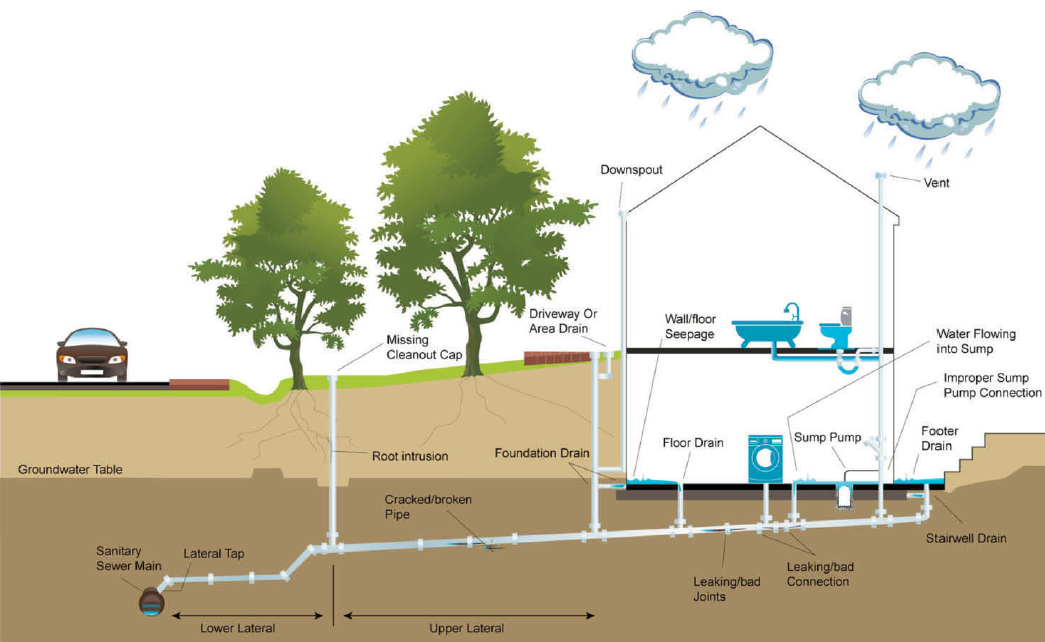
Figure 2. Common sources and pathways of infiltration and inflow associated with private property and sewer laterals. Source: Water Environment Federation (2016), Private Property Infiltration and Inflow Control.
Define the problem before choosing measures of success
PAC member Harshad Shetye of Crowe Engineers has encouraged the team to examine why each utility undertakes an I/I program. Partner discussions have also highlighted that short-duration peak-flow problems associated with overflows and building backups may require different evaluation time scales from longer-duration treatment-plant impacts. These perspectives are helping connect program objectives, investigation methods, and measures of success.
The preliminary synthesis distinguishes implementation, source-correction, hydraulic, service, economic, and long-term outcomes. Inspection counts, changes in peak flow, fewer backups, and avoided costs measure different things. Keeping these outcomes distinct will support case comparisons without treating every reported benefit as measured I/I reduction.
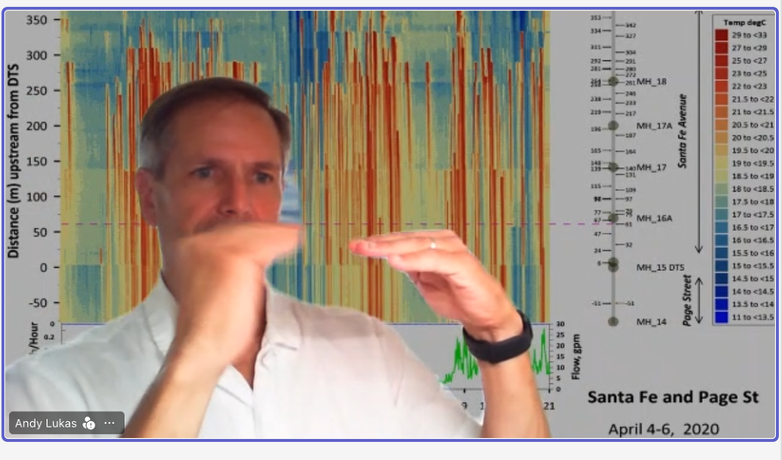
Figure 3. Andy Lukas of Brown and Caldwell shares technical insights during the WRF 5365 hybrid partner meeting on August 21, 2026.
Repair completion does not demonstrate I/I reduction
The research framework distinguishes a visible defect, a confirmed active I/I source, a completed repair, and a demonstrated hydraulic benefit. PAC member Jianan Cai of EPCOR has emphasized that completing a project does not necessarily establish actual I/I reduction. This distinction is central to the planned evaluation of technologies and practices.
The team is examining how corrective actions are matched to verified sources and followed by quality assurance, construction acceptance, and performance verification. Rainfall and groundwater conditions, monitoring quality, and comparison methods also matter when interpreting before-and-after results. The manual will address both what was installed and what the available evidence shows about its effect.
The review also distinguishes infiltration through a defective lateral or connection from inflow entering through building or site drainage connections, such as roof leaders, sump pumps, or foundation drains connected to the sanitary sewer. These sources require different corrective actions. Identifying the pathway first helps define the work, the parties who need to participate, and the evidence needed to evaluate the result.
Homeowner participation and long-term maintenance matter
Partner discussions have also drawn attention to homeowner communication and the practical limits of requiring corrective action. The synthesis distinguishes owner response, access authorization, inspection, repair decisions, and completion. Examining these steps separately can show where a private-property program encounters delays or loses participants.
Industry input has extended the research focus beyond construction to protecting completed repairs, continued monitoring, and long-term maintenance responsibility. Practical examples shared by partners will help the team examine how rehabilitated assets can be identified, protected, and maintained over time.
Industry support is shaping the next stage
Project partners are contributing technical advice and have offered documents, case studies, and professional time. Committed in-kind support substantially far exceeds the project’s minimum requirement, with commitments covering technical review, interviews, data sharing where possible, and workshops.
Partners have offered case-study leads, technical resources, utility experience, and potential data-sharing opportunities. Examples include distributed temperature sensing resources and cases involving infiltration control, private laterals, rehabilitation, and asset-record integration. The team will follow up on these contributions as the case-study work develops.
The project’s International Advisory Council includes partners from Finland, New Zealand, Hong Kong, Kuwait, the United Kingdom, and Singapore. WRF’s PAC provides a separate channel of technical guidance, with project coordination supported by Research Manager Jessica Metcalf and Project Administrator Corina Santos.
In the next stage, partner feedback, surveys, interviews, and case studies will deepen the evidence for evaluation and validation. Utilities and practitioners are invited to contribute relevant program documents, monitoring records, case examples, and lessons from both successful and less successful approaches. Case information may be anonymized where needed.
The Purdue team and BAMI-I thank all project partners, contributors, WRF staff, and PAC members for their time and continued support.
Confirmed partners
| Ace Pipe Cleaning, Inc. | Loudoun Water, Ashburn, VA |
| Atakapa Services, Inc. | MWS of Nashville and Davidson County, TN |
| Blue Heron | National Plant Services |
| Brown and Caldwell | Perma-Liner Industries (Singapore) Pte Ltd |
| CDM Smith | Pinellas County Utilities, Largo, FL |
| China Hong Kong Society for Trenchless Technology, Hong Kong | Pitts Fowler Enterprises, Inc. |
| City of Pompano Beach, FL | Sacramento Area Sewer District |
| City of Revere, MA | SANIPOR |
| Columbia Water, SC | South Carolina State University |
| Confluence Trenchless Solutions, LLC | Stamford WPCA, CT |
| County of Fairfax, VA — Department of Public Works and Environmental Services | Trenchless Groundwater Movers |
| Fort Wayne City Utilities Engineering, IN | TriCo Regional Sewer Utility |
| George E. Kurz, P.E. (TN), DEE (individual consultant) | Underground City Oy, Finland |
| Halifax Water | University of Birmingham, U.K. |
| HNTB | Waggoner Engineering |
| Hanouf Alhumaidi,Kuwait University, Kuwait | Waugh Infrastructure Management Ltd., New Zealand |
Additional organizations
Insituform Technologies; NASSCO; P3i-Tech Pte Ltd.
The team also acknowledges Kirkkonummi Water Utility and Great Lakes Water Authority for participating in the early technical exchanges.
Project information inquiries: Dr. Dulcy Abraham, [email protected] ; Dr. Tom Iseley, [email protected].