At first glance, the challenges facing underground infrastructure appear strictly technical. Utilities need better ways to locate lines, inspect deteriorating pipes, detect infiltration, and predict failures. The industry has responded with an explosion of capabilities: stepped-frequency multichannel GPR, multi-sensor platforms, and artificial intelligence.
Yet, a utility can possess thousands of inspection records and still not understand its system. It can purchase sophisticated technology but lack the data structure, workflow, or organizational responsibility necessary to turn that technology into better decisions.
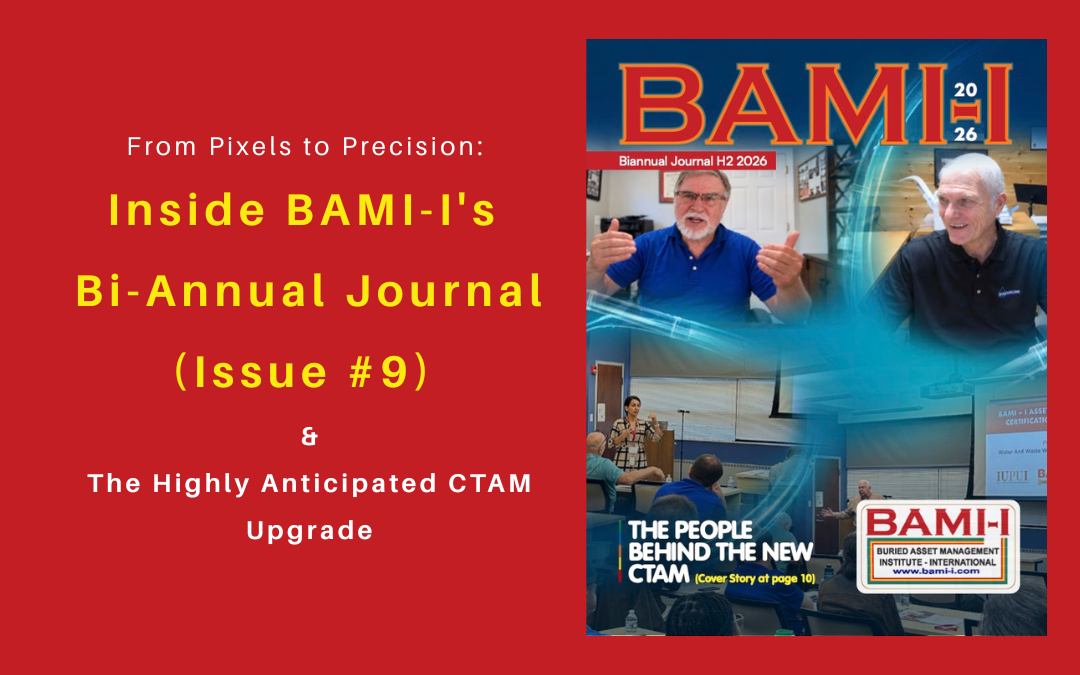
The newly released BAMI-I Journal H2 2026 addresses this exact friction point: the gap between collecting data and executing a capital plan.
The Foundation: The Long-Awaited Relaunch of CTAM
A buried pipe does not announce its remaining service life or tell a utility which asset needs attention first. Answering those questions requires reliable records, an understanding of condition, and the financial judgment to fund interventions.
This is the driving force behind the cover story of the H2 2026 Journal, which profiles the industry experts who have comprehensively updated BAMI-I’s Certification of Training in Asset Management (CTAM). By revising existing content and rewriting key sections for both water and wastewater systems across CTAM 100-400, this curriculum update ensures that utilities have a practical pathway to turn field information into sustainable financial plans. The updated program is expected to officially open for enrollment by the end of 2026, offering both virtual and live classroom options for organizations.
Traceability in the Age of AI
As artificial intelligence enters utility engineering, the journal tackles the critical need for evidence and traceability. As Greg Jeffries outlines in his piece on AI, algorithms can recognize patterns and process vast amounts of historical data, but AI cannot manufacture a higher level of confidence out of poor source data. The journal explores the necessity of the “chain of custody”—ensuring that AI-derived utility datasets include a complete accounting of the source information used to develop them, preserving the professional judgment that remains fundamental to our industry.
Real-World Utility Application
The journal grounds these concepts in applied utility experience:
-
North Texas Municipal Water District (NTMWD): Shares insights from a decade-long Condition Assessment Program, detailing why they structured their 147-mile large-diameter gravity main inspection program around multi-sensor inspection (MSI) to gather quantified data below the waterline.
-
Western Virginia Water Authority (WVWA): Demystifies digital transformation for mid-sized utilities, demonstrating that successful integration requires a balanced framework of systems, data, processes, and people.
-
Xinyu City Gas Utility: Highlights how to build a disciplined field workflow connecting mobile screening, trained canine search teams, and instrument verification into a single, accountable chain of custody.
Our underground infrastructure will always be partly invisible. Our knowledge of it does not have to be. Read the full insights by accessing the BAMI-I Journal H2 2026 through the BAMI-I website.