In the rapidly evolving landscape of utility management, the need for comprehensive and data-driven asset management practices has never been greater. The CTAM (Certification in Utility Asset Management) program provides education and tools for utility management, government, staff, and engineers seeking not only to deepen their technical knowledge but also to solidify their role as leaders in the industry.
The BAMI-I CTAM program has served the asset management community well for the past 10 years. So that it continues to serve well, it is in the process of receiving an upgrade regarding both its content and procedures.
The goal of the CTAM program has always been to assist small communities regarding their ability to manage their buried gravity pipe assets, particularly wastewater and storm water. The management of pressure pipe assets, including water mains and force mains, though not being ignored, has not received sufficient emphasis.
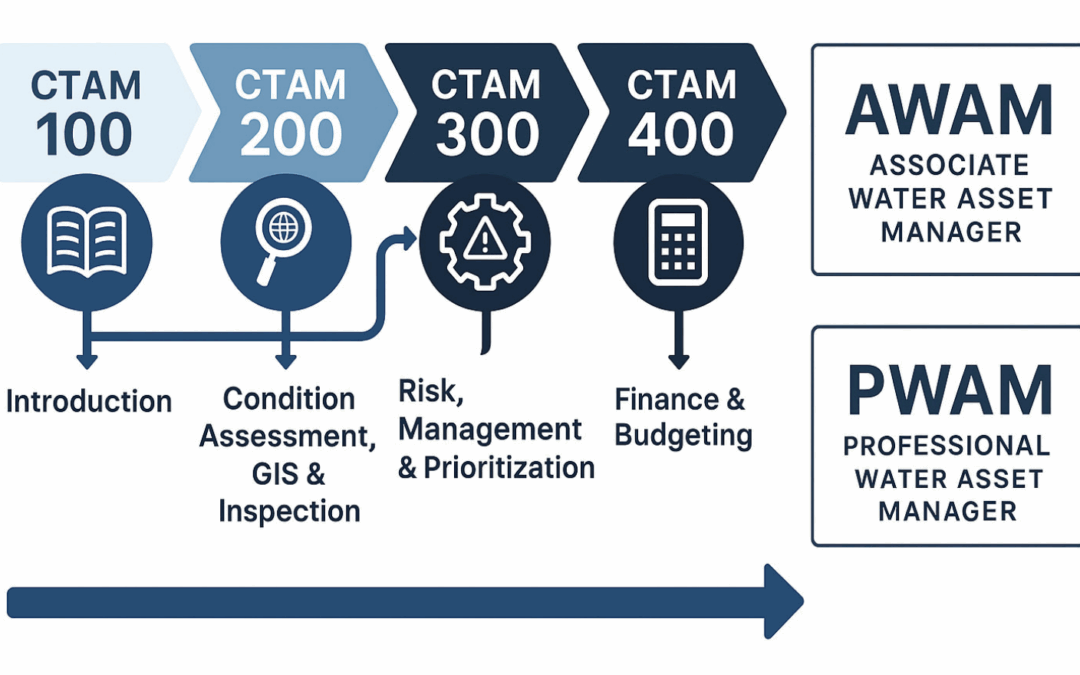
The current CTAM certification consists of four courses. CTAM 100 is an Overview of Asset Management. CTAM 200 involves the Development of an Asset Management Program. CTAM 300 trains the Managing of an Asset Management Program. Finally, CTAM 400 regards the Financing of an Asset Management Program. Courses are available online at your own pace or in a classroom with an instructor.
Through this process asset managers were able to become an Associate Water Asset Manager (AWAM) or with sufficient experience a Professional Water Asset Manager (PWAM).
The BAMI-I Board, desiring to assure that CTAM materials remains current, focused on the small utility goal, and more readily and frequently available has authorized a thorough review and revision to both the content and process of CTAM.
The content of CTAM will become even more focused upon assisting small utilities. These utilities of less than 25,000 customers are, by far, the majority of communities, have the same issues as larger utilities, but typically lack available resources. Our goal will also be to simplify and reorganize the content. In addition to continuing limited self-paced and local in-house training, our ultimate goal will be to also develop live, trainer-led courses to provide high-quality training without the need for travel or venue arrangements.
The current plan is to restructure CTAM 100 into an introductory, virtual, online, self-paced course focusing on the need for and history of asset management. It will consider the long-term and short-term goals of asset management and briefly introduce the eight basic questions to be answered by any asset management plan:
- What assets do we have?
- What is the asset’s location?
- What are the asset’s conditions and remaining useful life?
- What actions are required next?
- How much will it cost to maintain or repair each asset?
- What is the priority of the action?
- What is each asset’s current value?
- What is each asset’s current value?
CTAM 200 and CTAM 300 will each be developed into a one-day course that will be taught either in a live or virtual classroom by a trainer. We hope that this will enable a broader interest by making courses more accessible, feasible to develop, and attend. While much of the material will be the same, these two courses will be separated into two modules – gravity pipe management and pressure pipe management. Our desire is for both gravity and pressure pipe managers to receive targeted training.
CTAM 200 will focus upon condition assessment. It will focus on the first three of the basic questions:
- What assets do we have?
- What is the asset’s location?
- What are the asset’s conditions and remaining useful life?
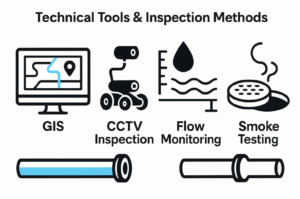
This course explains how GIS mapping can be employed to identify the assets a utility possesses and the locations of these assets. It will then address how flow monitoring, flow isolation, smoke testing, manhole inspection, and closed-circuit television (CCTV) inspection cab be used to determine the condition of the assets as this relates to the structure of the asset and the capacity issues related to an asset. It will also explain how the GIS process links assessment to the mapping. CTAM 200 will explain how a utility will obtain the essential information necessary to develop an asset management plan.
CTAM 300 will focus upon using the foundational information gained by mapping and condition assessment to develop and manage an asset management plan. To do this, it will focus upon the next few questions:
- What actions are required next?
- How much will it cost to maintain or repair each asset?
- What is the priority of the action?
We will consider how Likelihood and Consequence of Failure (LoF/CoF) can be developed and used to establish what risk an asset has and how to use this to prioritize immediate, ongoing, and future asset rehabilitation, replacement, maintenance, and ongoing assessment priorities either to eliminate gaps or build upon existing benchmark data. These are essential for setting and maintaining a utility’s asset management current, ongoing, and future budget. All of this must be based upon the codified Level of Service that a utility expects to deliver.
CTAM 200 and 300 courses will be designed specifically for engineers and asset managers who handle the intricate aspects of each asset’s management.
CTAM 400 targets utility managers, accountants, and government officials. This discussion will address the final two financial based questions:
- What is each asset’s current value?
- What is each asset’s current value?
This will also be a live class that can either be virtual or in a classroom. It will examine how asset management principles can determine the overall value of utility assets, set rates, and budget for future needs.
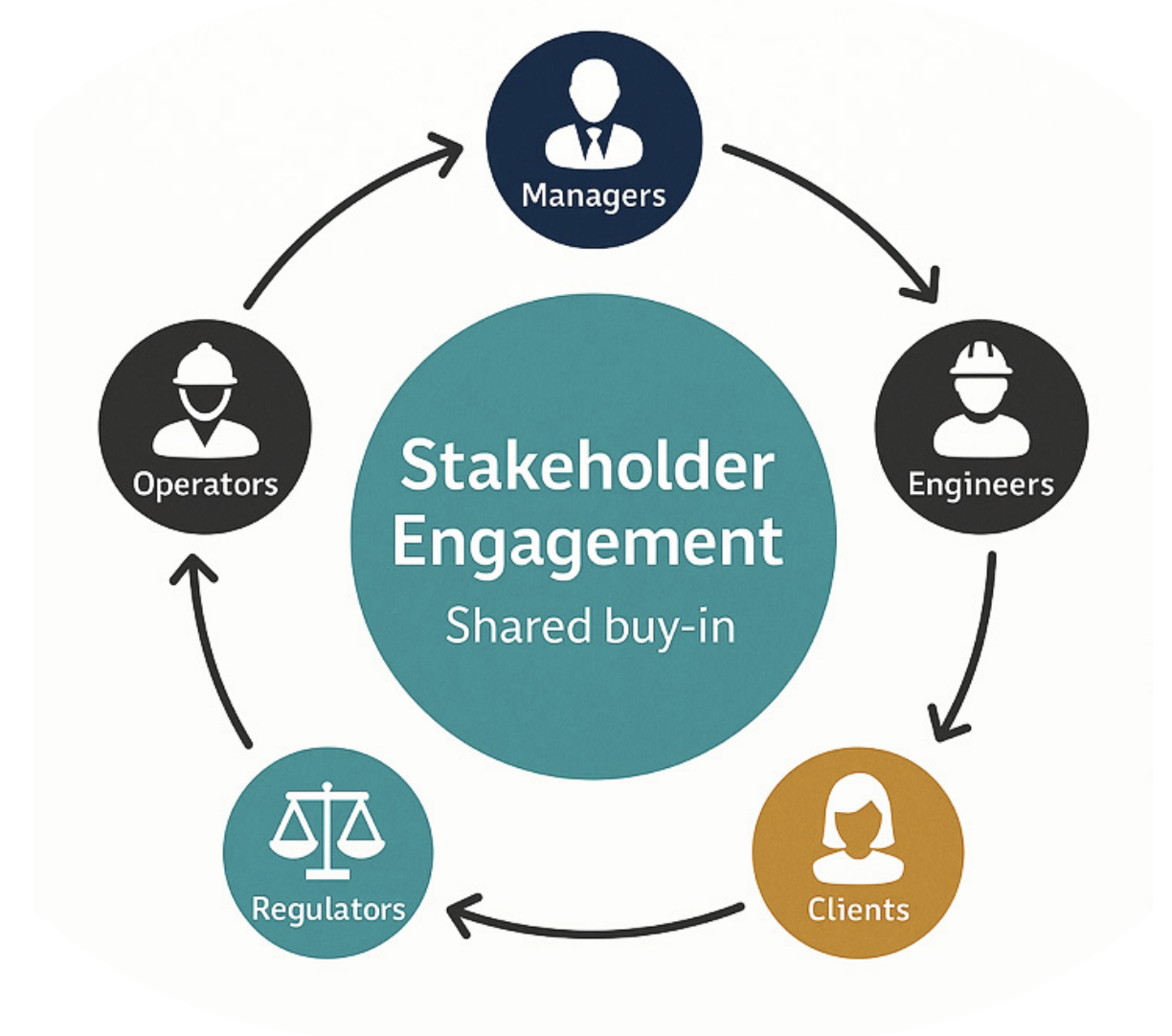
The entirety of CTAM will emphasize the need for all the stake holders in a utility – management, engineering, operations, board/council, regulators, and customers – to share in the process and “buy in” to the plan. Without this, a plan, regardless of how well it is constructed, will have limited chances of success.
By fostering collaboration and transparency among all parties involved, utilities can create resilient asset management strategies that adapt to changing regulatory, technological, and financial landscapes. Encouraging ongoing professional development through initiatives like the CTAM courses ensures that personnel remain equipped with the latest methodologies and tools. Ultimately, when stakeholders are actively engaged, utilities are empowered to make data-driven decisions that optimize resource allocation, protect critical infrastructure, and uphold their commitment to reliable, high-quality service delivery for the communities they serve.
Author:

Jim Harris
Senior Project Engineer, Retired from Jacobs Engineering
BAMI-I Board of Directors