Asset Management Through Material Optimization: A Hybrid FRP–Steel Pipeline Solution for the Columbia Improvement District Irrigation System
Sanaz Ghalambor, PhD
Carl Pitzer, PE
Abstract
Effective asset management begins long before a pipeline is placed into service. Although asset management is commonly associated with inspection, maintenance, and rehabilitation, many of the factors that determine long-term system performance are established during planning and design. Material selection, constructability, hydraulic efficiency, corrosion resistance, maintenance requirements, and life-cycle cost all influence the value an infrastructure asset provides throughout its service life.
The Columbia Improvement District (CID) Pipeline Project in Oregon illustrates how an asset management philosophy can guide engineering decisions during design. Rather than selecting a single pipe material throughout the alignment, the project team evaluated the strengths and limitations of multiple materials and developed a hybrid system utilizing fiberglass reinforced polymer (FRP) pipe for the majority of the alignment and strategically located steel fittings where restrained joints were required. This approach optimized constructability, reduced installation time, minimized long-term maintenance, and lowered life-cycle costs while satisfying structural and hydraulic requirements.
This paper demonstrates that selecting the appropriate material for each portion of an infrastructure system can significantly improve long-term asset performance and should be considered an integral component of asset management.
Introduction
Water infrastructure owners are under increasing pressure to maximize the return on infrastructure investments while controlling construction costs, reducing maintenance, and extending service life. Traditionally, pipeline material selection has often been driven by familiarity, initial construction cost, or specification preferences. Asset management, however, encourages a broader perspective in which engineering decisions are evaluated over the entire life cycle of the asset.
The goal is no longer simply to build a pipeline that meets today’s design requirements, but to develop an infrastructure system that minimizes risk, reduces operational costs, improves reliability, and provides sustainable performance for decades.
This philosophy aligns closely with modern asset management principles. Decisions made during design directly influence future inspection requirements, maintenance costs, rehabilitation frequency, hydraulic efficiency, energy consumption, operational reliability, and ultimately the total cost of ownership.
The Columbia Improvement District Pipeline Project provides an excellent example of this approach.
Project Background
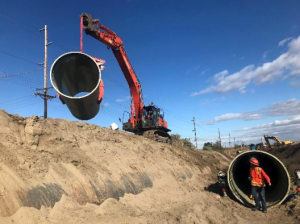
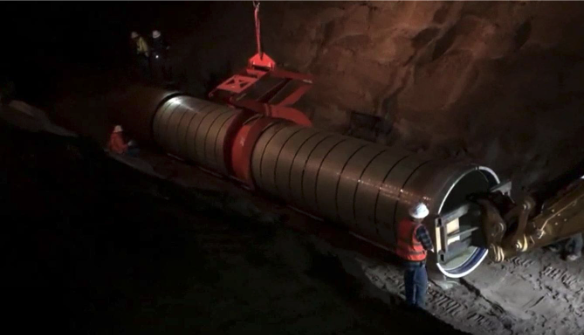
Declining groundwater availability within Oregon’s Umatilla Basin created an urgent need for a reliable irrigation water supply. To address this challenge, the Columbia Improvement District initiated construction of approximately 39,000 linear feet of large-diameter transmission pipeline to convey Columbia River water to agricultural users throughout the district. The system consisted of approximately 39,000 feet of 72-inch pipeline operating at 180 psi plus surge pressure. The project was delivered through a public procurement process in which the material supply contract was separate from construction, requiring close coordination among the owner, engineer, supplier, and contractor.
Beyond the hydraulic demands, the project presented several engineering challenges, including a complex alignment with numerous horizontal and vertical curves, winter construction conditions, restrained joint requirements, and pressure demands exceeding the availability of standard restrained FRP coupling systems at this diameter. These constraints required the project team to evaluate alternatives beyond conventional single-material solutions.
Asset Management Begins During Design
Asset management is frequently associated with inspection programs, condition assessment, and rehabilitation planning. While these activities are essential, they occur only after the asset has been constructed. Many of the most significant opportunities to reduce future costs occur much earlier.
The selection of pipeline materials directly affects:
- service life,
- corrosion resistance,
- hydraulic performance,
- constructability,
- maintenance frequency,
- energy consumption,
- operational reliability, and
- future rehabilitation requirements.
Consequently, selecting the appropriate material should be viewed as an asset management decision rather than simply a design choice.
For the CID project, engineers evaluated multiple alternatives while considering both initial construction and long-term operational performance.
Evaluation of Alternative Material Systems
- All-Steel Pipeline
Steel has long been used for high-pressure transmission systems because of its strength and ability to accommodate fully restrained welded joints. However, when evaluated from a life-cycle asset management perspective, several disadvantages became apparent for this project.
Construction during winter conditions would have significantly reduced welding productivity and extended installation schedules. Steel pipe sections also require heavier lifting equipment, extensive field welding, and additional field operations associated with welded pipeline construction, increasing labor demands and installation complexity. Depending on the project-specific service environment and design approach, steel pipelines may also require corrosion protection measures, such as protective coatings, cathodic protection systems, sacrificial anodes, or additional corrosion allowance. Over the long term, corrosion and internal roughness can reduce hydraulic efficiency, potentially increasing pumping costs and maintenance requirements.
Although structurally suitable, the all-steel option represented a less favorable solution from a constructability and life-cycle asset management perspective.
- All-FRP Pipeline
FRP provided numerous advantages aligned with long-term asset management objectives.
Its corrosion resistance eliminates the need for cathodic protection while maintaining a smooth internal surface that minimizes head loss throughout the pipeline’s service life. Lightweight construction simplifies transportation, handling, and installation while reducing equipment requirements. Standard double-bell couplings also enable rapid installation without welding, electricity, or specialized welding crews.
However, the project also exposed practical constructability limitations for an all-FRP solution under the specific project conditions. While restrained joints using flanges and field laminations are well-established methods for FRP pressure pipelines, implementing these systems efficiently for a 72-inch-diameter, high-pressure pipeline during winter construction presented significant constructability and schedule challenges. Extensive field laminations would have required considerable field labor and curing time under cold weather conditions, increasing installation complexity and reducing productivity. So, relying on field laminations throughout the project was not considered the most efficient solution. Concrete thrust blocks were also evaluated but were not preferred by the owner because of constructability considerations. Consequently, neither a conventional all-steel nor an all-FRP solution provided the optimum balance of constructability, schedule, and long-term asset management objectives.
Hybrid Material Optimization
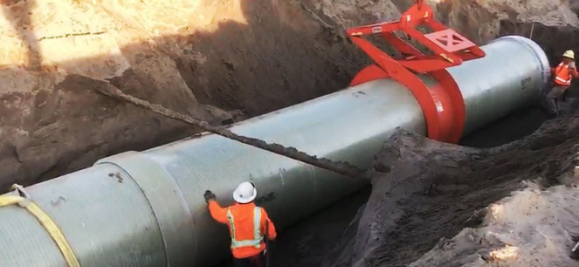
Rather than selecting one material throughout the entire alignment, the project team adopted a hybrid approach.
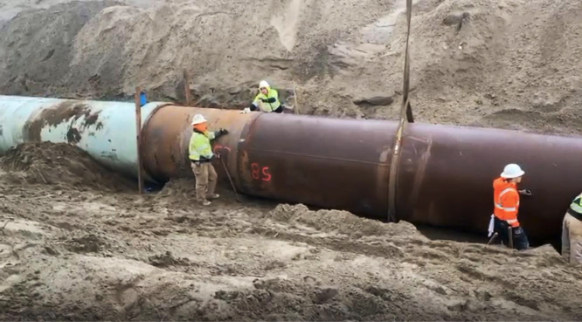
FRP pipe was utilized throughout the majority of the alignment, where its corrosion resistance, hydraulic efficiency, and rapid installation provided maximum benefit. Steel fittings were incorporated only at locations where restrained joints were required to resist thrust forces generated at bends and major alignment changes. Custom-designed FRP-to-steel adapters allowed seamless integration between the two materials while maintaining compatibility with standard FRP couplings.
This solution demonstrates a fundamental principle of asset management: infrastructure systems should be optimized according to functional requirements rather than constrained by a single material selection philosophy.
Constructability as an Asset Management Strategy
Constructability is frequently viewed as a contractor concern; however, it also represents an important asset management consideration because construction complexity directly affects project cost, schedule, and risk.
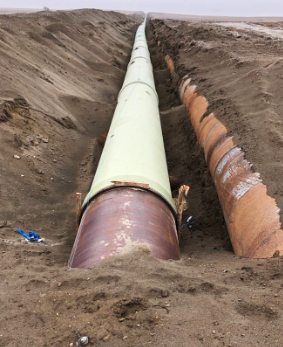
The hybrid system reduced field welding, minimized heavy lifting requirements, and allowed most alignment changes to be accommodated using standard FRP couplings capable of angular deflection. Steel fittings were required only at critical locations, while FRP pipe lengths were optimized for transportation, handling, and rapid assembly.
Installation productivity exceeded approximately 1,500 feet per day compared with approximately 700 feet per day for a fully welded steel system under similar conditions, despite construction occurring during winter.
From an asset management perspective, reduced construction duration lowers project risk, minimizes labor exposure, and accelerates delivery of infrastructure into service.
Life-Cycle Value Engineering
The project team continued applying asset management principles during detailed design through value engineering.
Approximately 1,000 feet of steel pipe was replaced with FRP where structural demands permitted. In addition, approximately half of the pipeline was increased to a 75-inch diameter, allowing efficient nesting of 72-inch pipe during transportation while also improving hydraulic performance. The optimized design reduced shipping costs, simplified logistics, lowered pumping energy requirements, and achieved an estimated 30 percent cost savings compared with all-steel or all-FRP alternatives.
These decisions illustrate that value engineering should not focus solely on reducing initial construction costs. Instead, it should seek to maximize the total value delivered throughout the asset’s service life.
Manufacturer Collaboration as Part of Asset Management
Modern asset management extends beyond utility owners and designers. Material manufacturers increasingly contribute engineering expertise during project development, helping optimize constructability, cost, logistics, and long-term performance.
On the CID project, Thompson Pipe Group (TPG)’s ability to manufacture both FRP and steel pipeline systems proved particularly valuable. Unlike suppliers limited to a single material, TPG evaluated the project as an integrated system rather than attempting to maximize the use of one product. This flexibility enabled the development of a project-specific hybrid solution that combined the corrosion resistance and hydraulic efficiency of FRP with the structural advantages of fabricated steel fittings only where required.
TPG also designed and manufactured the custom FRP-to-steel transition adapters, coordinated fabrication of both material systems, optimized pipe lengths for transportation and installation, and supplied the complete hybrid pipeline under a single procurement package. Single-source responsibility reduced coordination risks between suppliers, improved compatibility among components, simplified logistics, and accelerated responses during construction.
Lessons for Asset Management
The CID project demonstrates several important asset management principles.
First, selecting the appropriate material for each application often produces better long-term performance than requiring a single material throughout an entire system.
Second, constructability should be recognized as a component of asset management because safer, simpler, and faster construction reduces project risk and overall cost.
Third, hybrid infrastructure systems can capitalize on the strengths of multiple materials while minimizing their individual limitations.
Finally, life-cycle thinking should guide engineering decisions. Corrosion resistance, hydraulic efficiency, maintenance requirements, transportation logistics, installation productivity, and future operational costs are all interconnected and should be evaluated together rather than independently.
Conclusions
The Columbia Improvement District Pipeline Project demonstrates that asset management begins during infrastructure planning and design. By evaluating both initial construction and long-term operational performance, the project team developed a hybrid FRP-steel pipeline system that balanced structural requirements, constructability, hydraulic efficiency, corrosion resistance, and maintenance considerations.
Instead of viewing pipeline materials as competing alternatives, the project illustrates the value of integrating complementary materials into a unified engineering solution. The resulting hybrid system improved installation productivity, reduced construction costs, minimized future maintenance requirements, and enhanced long-term asset performance.
As utilities continue to face aging infrastructure, increasing financial constraints, and growing expectations for sustainable investment, projects such as the CID Pipeline demonstrate that material optimization can become a powerful asset management strategy. Rather than asking which material is best, engineers should ask which material is best suited for each portion of the system. That shift in perspective represents one of the most important opportunities to improve the performance and value of future buried infrastructure assets.