Lessons Learned through the Switz City Asset Management Plan
A Real Story from a Real Project: How a Small Indiana Town Built Its Path to Sustainable Infrastructure
By Wei Liao & Adam Hershberger
1. Introduction: The Reality of Small Utilities
Across America, thousands of small utilities face the same fundamental challenge: aging infrastructure, limited resources, and a reactive “fix it when it breaks” approach to system management. While large metropolitan water systems have access to dedicated engineering teams, sophisticated data platforms, and diversified funding streams, small communities often struggle with bare-bones budgets, skeleton staff, and infrastructure that was installed decades ago with little documentation.
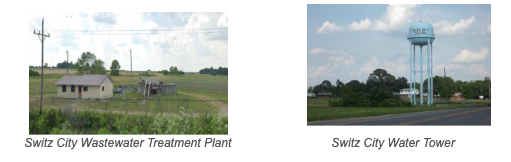
Switz City, Indiana, is one such community. With a population of just 268 residents within city limits and a water service area covering approximately 870 people, this small Greene County town operates both water and wastewater systems that face challenges identical in nature—if not in scale—to those of the nation’s largest utilities. Their daily water demand is approximately 120,000 gallons, served by 28 miles of water mains with 348 connections, a single water tower, 5 miles of wastewater mains, 79 manholes, one treatment plant, and 4 pump stations.
This article documents the lessons learned through the development of a comprehensive Asset Management Plan (AMP) for Switz City, a project that began with zero budget and evolved into a $650,000 funded initiative. It offers practical insights that other small communities can adapt to their own contexts, while making a critical argument: state-level support is not optional—it is essential for small utility survival.
2. Project Genesis: From Zero Budget to Funded Initiative
2.1 The Volunteer Phase (January 2023 – July 2024)
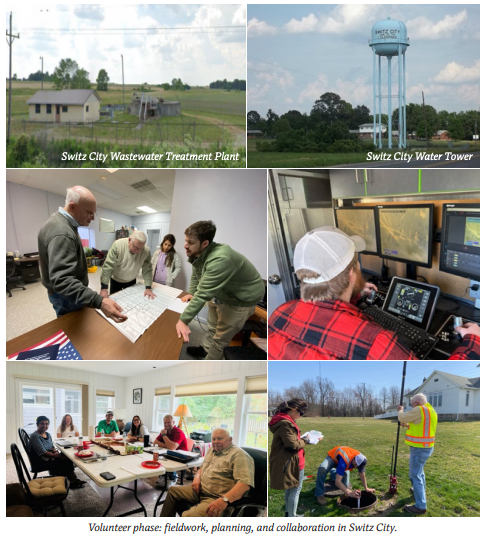
The Switz City AMP project began not with a grant award or a contract, but with a decision to act despite having no funding. For 18 months, the project operated entirely on volunteer effort. During this phase, the team accomplished three critical tasks that laid the foundation for everything that followed.
First, the team developed an inspection strategy, determining what assets to inspect, how to inspect them, and in what order. Second, the team defined the project scope—identifying what could be included immediately, what could wait, and what absolutely could not be deferred. Third, the team built partnerships with industry, academic, and individual contributors who donated their time and expertise.
During this phase, the team built a risk-based methodology that was simple and practical for small systems. They gathered all available records, built GIS maps, created an asset inventory, and conducted preliminary fieldwork including acoustic screening using SLR
technology. When high-risk pipes were identified, industry partners were invited to perform CCTV inspection at no cost. The project was also integrated into Purdue University’s asset management course, where five student teams developed complete AMPs as course projects, turning Switz City into a living laboratory.
The volunteer phase proved a powerful principle: nobody got paid, but everyone got value. Industry partners gained field demonstration opportunities, students gained real-world experience, and the community gained a foundation for its infrastructure future.
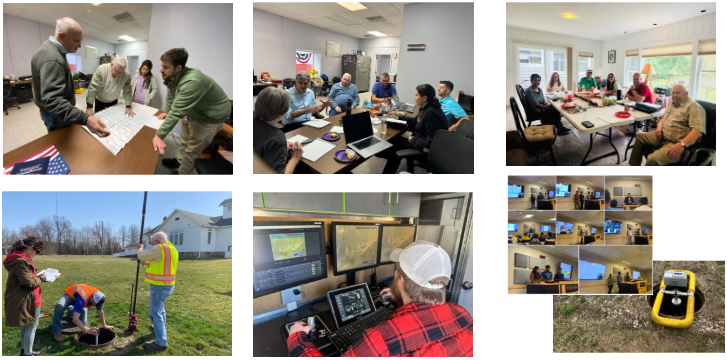
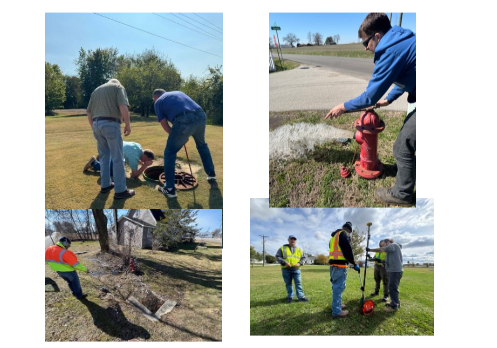
Collaborative fieldwork and planning in action: Building a risk-based asset management foundation
2.2 Transition to Full Execution
The volunteer phase culminated in an interim plan that was presented to the Indiana Finance Authority (IFA), resulting in a $650,000 funding award. This funding was divided into two categories: $250,000 for AMP development and $400,000 for urgent repairs and system upgrades.
With funding secured, the team expanded significantly. Technical partners including ADS
On-site asset assessment and field verification activities
Environmental Services, ACE Pipe Cleaning, Kurt Wright Consulting, and USG Water Solutions joined the effort. Financial expertise was brought in through Glenn Barnes of Water Finance Assistance (WFA) and Heather Himmelberger. Critically, Smart Views LLC was engaged for independent data review to ensure reliability and accuracy—a decision that proved invaluable.
3. Building the Data Foundation
The second phase focused on building a comprehensive data foundation for the asset management plan. This involved creating a complete system inventory, conducting condition assessments across all assets, and confronting the reality of data management limitations in a small utility environment.
Comprehensive inspections were conducted across the entire system: flow monitoring, CCTV inspection of the complete wastewater system, manual manhole inspection, smoke testing for infiltration detection, and elevated tank interior and exterior assessments. A hydrant flushing exercise was also completed.
The data management reality, however, was sobering. While GIS served as the spatial backbone, operations and maintenance records, inspection data, and financial information all existed in separate files and platforms. Quality control relied on external review rather than built-in system rules, and data updates required manual coordination. The team did not have a true integrated data management system—a common reality for small utilities across the country.
4. Critical Infrastructure Challenges Revealed
The data collected during the assessment phase revealed the true scale of Switz City’s infrastructure challenges—numbers that were, in the project team’s words, “shocking.”
On the water side, the system showed a 78.6% increase in water loss, with non-revenue water costs rising from $60,428 in 2019 to $107,941 in 2023. The Infrastructure Leakage Index stood at 16.86—far exceeding the industry benchmark of less than 3.0. Multiple hydrants and valves were inoperable, and aging cast iron mains were actively failing during the project period.
On the wastewater side, the infiltration and inflow (I&I) rate reached 46%, causing severe hydraulic overload. According to flow monitoring data, daily flows exceeded the treatment plant’s capacity on 102 of 110 study days—a staggering 93% exceedance rate. Critical assets including the effluent outfall, valves, and key pipe segments required immediate replacement.
These numbers, while alarming, are not unusual for small utilities. The difference is that most small towns simply have not collected the data to quantify their problems. Switz City now had the numbers—and with them, the ability to make informed decisions.
5. From Data to Decisions: The Continuous Loop
A fundamental lesson from this project is that asset management is not a one-time project—it is a continuous cycle. The team developed a decision framework built around four interconnected elements: Inspection & Data collection, Risk & Priority scoring (using Probability of Failure × Consequence of Failure = Risk Score), Decision-making (repair vs. replace, maintenance vs. capital), and Financial Impact analysis (rates, funding, and phasing).
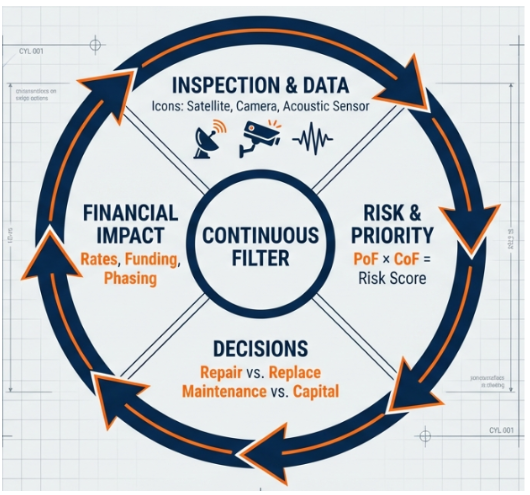
This framework ensures that as new data comes in—from ongoing inspections, operational events, or system changes—the plan adapts accordingly. The capital improvement list generated in year one will inevitably change as conditions evolve, and the AMP must be treated as a living document rather than a static report.
6. A 20-Year Investment Strategy
Based on the comprehensive assessment, the team developed a phased 20-year capital improvement strategy totaling $3.72 million. The strategy was designed around a critical principle: capital smoothing. Rather than allowing all infrastructure needs to accumulate and hit at once, investments are spread across three phases to maintain affordability.
Phase 1 (Immediate, Year 0–1): $400,000 allocated to urgent repairs and upgrades, focusing on critical failure points and compliance requirements. Phase 2 (Short-term, Year 2–5): I&I reduction and manhole rehabilitation through systematic lining and spot repairs to reduce excess flow. Phase 3 (Long-term, Year 5–20): Risk-based asset renewal with capital smoothing to prevent investment spikes.
Affordability is fundamentally a financial decision. The best engineering plan means nothing if the community cannot afford it. The project team worked with financial experts and grant partners to balance technical needs with community capacity. The funding mix was structured as approximately 60% SRF loans, 30% operating revenue, and 10% grants, with a phased rate implementation to reduce customer shock.
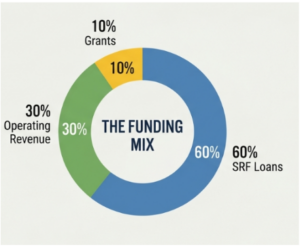
The funding mix and affordability strategy
7. Lessons Learned
The Switz City AMP project yielded eight critical lessons that are applicable to small utilities nationwide. These lessons span the domains of data management, technology adoption, governance, and policy.
7.1 Data Reality
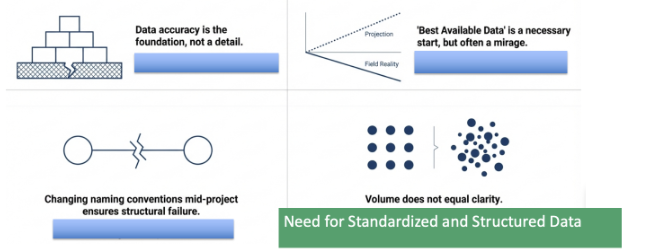
Lesson 1: Data accuracy is the foundation, not a detail. Wrong data leads to wrong decisions and wrong priorities. The transition from the interim plan (based on best available data) to the comprehensive plan (based on field-verified data) fundamentally changed the project’s direction. What appeared to be a manageable situation turned out to be far more severe when actual conditions were measured.
Lesson 2: ‘Best available data’ is a necessary start, but often a mirage. Initial estimates and projections diverged dramatically from field reality. The water loss numbers and I&I rates shocked the team because they were so far removed from what the existing records suggested.
Lesson 3: Changing naming conventions mid-project ensures structural failure. With multiple vendors working on the system, each applied their own naming rules to newly discovered assets. This created enormous reconciliation challenges and made it difficult to cross-reference with historical records. A firm naming convention must be established at the outset of any asset management initiative.
Lesson 4: Volume does not equal clarity—data must be standardized and structured. More data without standardization can create chaos rather than insight. The emphasis must be on data quality, consistency, and format standardization from the beginning.
7.2 Data Platform Reality
Lesson 5: Small utilities need a simple, unified data platform. Different types of data—operational, financial, inspection, compliance—were stored separately across spreadsheets, GIS, and paper files. Some small utilities, like the Town of Reno, Indiana, still rely entirely on paper records for daily operations.
The ideal platform for small utilities is fundamentally different from what serves large systems. It must be a single, centralized platform that is easy to use with a minimal learning curve, connecting everything from financial data and operations records to inspection results and compliance documentation. When data lives in one accessible source, operators eliminate transcription errors, reduce delays, and can update information in real time. Most importantly, a unified platform allows the utility to own its data and its future, reducing dependence on outside consultants.
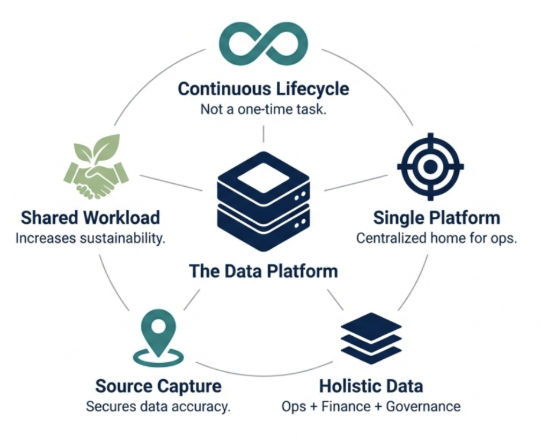
The data platform vision — continuous lifecycle, single platform, holistic data, source capture, and shared workload.
7.3 Technology as a Management Multiplier
Lesson 6: Technology is the management multiplier. A small town with one or two staff members can manage their system like a utility ten times their size—but only if they embrace technology. Technology in asset management is not about automation; it is about enabling timely decisions, making hidden risks visible, and supporting the execution of the asset management plan with better data.
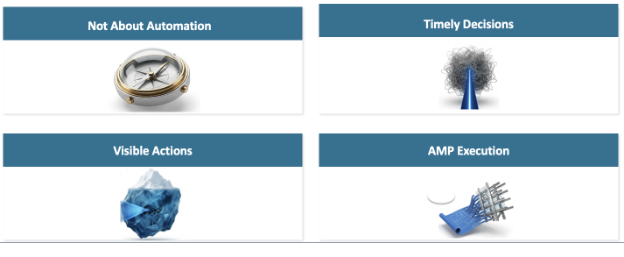
Four dimensions of technology as a management multiplier
Two case examples from the Switz City project illustrate this principle powerfully.
Smart Metering (Kamstrup): When old meters were replaced with smart meters, the technology not only simplified data reading but also detected abnormal consumption patterns through its analytics dashboard. The system identified a major hidden leak in an abandoned backyard. After repair, daily water demand dropped from 130,000 gallons to 80,000 gallons—a 38% reduction that directly supported the asset management schedule.
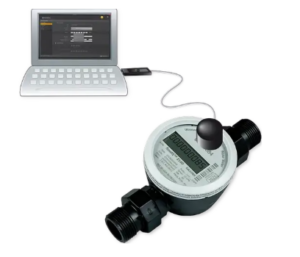
Kamstrup water meter
Asset Mapping (4M Analytics): During CCTV inspection, the team discovered a bore hole through a wastewater pipe. Using 4M Analytics’ comprehensive utility mapping, they could immediately identify the intersecting infrastructure—determining that the crossing line was a Duke Energy power line. This real-time cross-system visibility dramatically improved field decision-making efficiency.
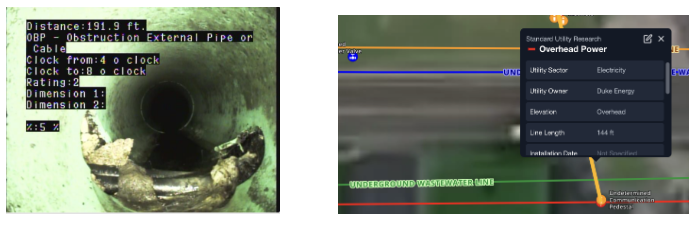
7.4 Key to Sustainable Asset Management
Lesson 7: Asset management should be a living system, not a static report. Without governance buy-in at every level—board, operations, staff, and community—the asset management plan becomes a shelf document that is filed away and forgotten, while operations continue as before.
Sustainable asset management requires understanding that it is a long-term, phased process that must deepen over time. Transparency with stakeholders is essential. Governance determines success: board approval, education, joint implementation planning, and addressing the reality that many small utility boards lack technical or economic utility backgrounds are all critical factors.
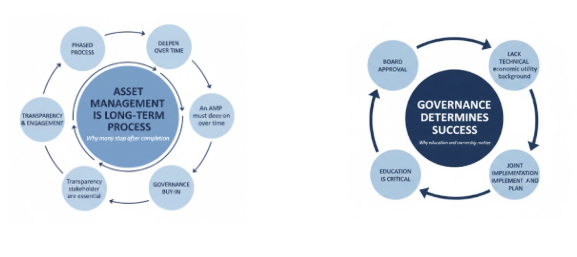
Why many AMPs fail after completion — the governance and process imperatives
7.5 Small Utilities Cannot Do This Alone
Lesson 8: This is the most important lesson for policymakers. Small utilities fundamentally lack the staff, time, and technical depth required for independent AMP execution. Developing a comprehensive asset management plan independently is cost-prohibitive for small systems. Personnel and knowledge gaps—in engineering, financial analysis, GIS, and asset management—are the primary bottlenecks.
The Switz City project required the coordinated effort of numerous industry partners, individual experts, educational contributors, financial specialists, and data quality reviewers. Expecting small systems to replicate this effort independently is, as the project demonstrated, both unrealistic and unfair.
The hard truth: Policy mandates without support mechanisms will fail. Indiana’s SEA 272 (2022) requires utilities seeking IFA funding to have asset management plans—a positive policy step. But without corresponding support structures, the mandate becomes an unfunded burden on the communities least equipped to bear it.
8. The Solution: State-Level Pooled Support
The Switz City experience points toward a clear solution: state-level integration of resources and support through a shared services model. This approach has two pillars.
Pooled Funding: Coordinate agencies such as IFA, USDA, OCRA, and FEMA so that small towns do not have to navigate five separate bureaucracies to secure funding. A single coordinated funding pathway dramatically reduces the administrative burden on resource-constrained communities.
Pooled Expertise: Create a statewide shared services model for technical assistance—providing engineers, financial analysts, GIS specialists, and asset management professionals as shared resources that small utilities can access without bearing the full cost independently.
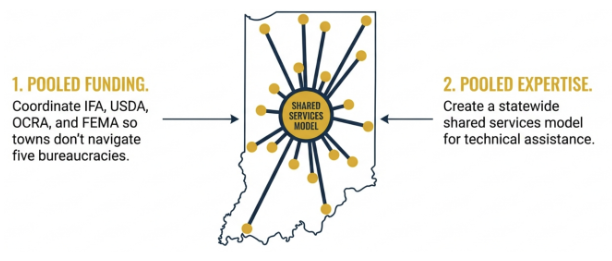 The shared services model — pooled funding and pooled expertise
State-level integration is not just helpful—it is a sustainable path to preventing future infrastructure collapse. The concept of a Water Innovation and Infrastructure Center, as introduced by Dr. Tom Iseley, embodies this vision: a centralized support structure that enables every small utility in the state to develop and maintain viable asset management plans.
9. Conclusion
The Switz City Asset Management Plan project demonstrates both the possibility and the complexity of bringing proactive infrastructure management to America’s smallest utilities. Starting with zero budget and growing into a $650,000 funded initiative, this project transformed a reactive, crisis-driven approach into a data-informed, strategically phased 20-year investment plan.
The eight lessons learned—spanning data accuracy, naming conventions, data standardization, platform simplicity, technology adoption, governance sustainability, resource reality, and pooled support—provide a practical roadmap for any small community facing similar challenges. But the most critical lesson is systemic: the current model of expecting small utilities to independently deliver comprehensive asset management is structurally flawed.
The path forward requires a fundamental shift from individual burden to collective capacity. From crisis to opportunity, from reactive to proactive—this is the future of utility asset management.
Switz City Project Hub: bami-i.com/projects/switzcity
About the authors
Wei Liao,Lead Research Engineer at Purdue University
Adam Hershberger, environmental specialist at Alliance of Indiana Rural Water