Brief History of the North Platte Sanitary Sewer Interceptor
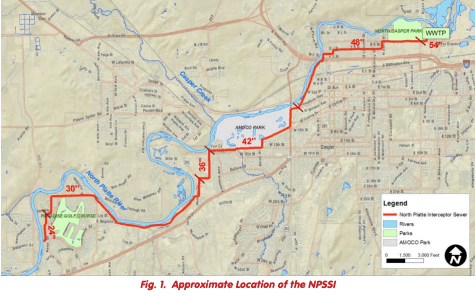
The City of Casper owns and operates an extensive wastewater conveyance system that includes the North Platte Sanitary Sewer Interceptor (NPSSI). The NPSSI was designed and constructed in four phases from 1980 to 1983 and ranges in diameter from 24″ to 54″. The NPSSI was part of an effort by the City to regionalize treatment of wastewater within the Casper Metropolitan Service Area (CMSA). The total length of the NPSSI is approximately 48,200 feet and is constructed of unlined reinforced concrete pipe (RCP).
Its location along the North Platte River is shown in Figure 1. Concerns with observed corrosion associated with hydrogen sulfide (H2S) prompted the City to undertake a carefully constructed condition assessment program. Although initially designed for significant planned growth, actual daily flows had increased only marginally since its construction and daily flow rates through the NPSSI have resulted in lower than expected velocities and very elevated levels of H2S within the NPSSI.
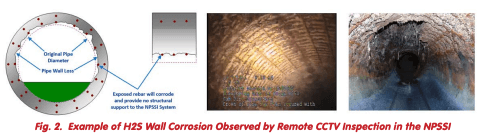
Currently the NPSSI remains “oversized” for current and projected average and peak flows. With future velocities remaining well below fps, this means that very elevated levels of hydrogen sulfide (H2S), particularly in the ambient air (head) space within the NPSSI, can be expected. The highest concentrations of atmospheric H2S are in the lower/downstream portions of the system. Consequently, the H2S and associated sulfuric acid formation became very problematic almost immediately after its construction along the entire interceptor alignment, causing serious deterioration of the NPSSI. Examples of corrosion are illustrated in Figure 2 and its impact on the reinforcement of the RCP infrastructure.
The focused work associated with the assessment and rehabilitation needs of the NPSSI began in earnest in 2011 over a three-year planning period. Following a series of phased/progressive inspection and assessment work, a risk-based asset management plan was then created by the project team. This finally led to the first major pipeline restoration and rehabilitation project that addressed nearly all of the high-risk sections of the NPSSI.
This work was completed in early 2023. These sections of City’s NPSSI were fully rehabilitated and restored with the confidence that it will be worry-free system for the next 75-100 years. The project team that studied, designed, and provided construction management services over this 12-year period included Jacobs, CEPI, and Blue Water Solutions Group.
This current article is the first of a two-part series that presents the strategic plan developed by the project team and implemented by this same team so that the stage could finally be set for what will be presented in the second article, specifically the long-awaited $7.0 trenchless rehabilitation project to improve and restore the most critical sections of the NPSSI beginning in mid-2022 and wrapping up in early 2023. This project included 7,600′ of 48-54″ of trenchless pipe rehabilitation along with numerous point repairs, new junction structures, and improved river siphons and inlet/outlet structures.
Despite record-setting winter weather conditions and numerous site challenges that were encountered almost daily, the project was completed on time and under budget. The NPSSI project demonstrates that the successful renewal of a large-diameter wastewater interceptor within a stream-sensitive aquifer and under harsh winter conditions can be done using trenchless renewal in the best way possible.
Finally, this current article (and an additional one to appear in the next quarterly BAMI-I journal) will present the strategic approach that was developed by a committed program team to design, bid, fund, and rehabilitate this severely deteriorated, but critical, wastewater conveyance asset using advanced but sensible cost-saving technologies. It was by all measures a phenomenally successful outcome.
Overview of Two-Part Inspection, Condition Assessment, and Risk Analysis of the NPSSI System
In 2011 the NPSSI program team members developed a cost-saving tiered (and phased) approach to assess the current condition of the NPSSI. This strategic plan evolved from a series of workshops and presentations to all project and NPSSI stakeholders, including those who would be engaged in the funding of the program outcomes. Once a formalized Project Work Plan (PMP) was developed, the team was ready to mobilize to the field and begin.
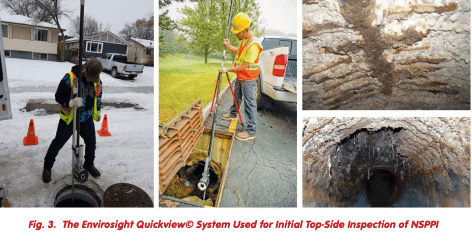
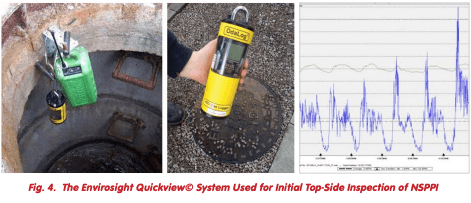
Under Phase 1, an initial inspection of the NPSSI manhole structures and pipeline assets was conducted using top-side internal inspection technologies that included the Quickview system (shown in Figure 3). The goal of this first phase was to (a) avoid entry into the NSPPI and use top-side and remote tools and technologies to conduct an initial higher-level assessment of pipelines, structures, connections, and maintenance-related conditions.
At the same time a short term strategy was developed and implemented to monitor seasonal impacts of wastewater flows through the NPSSI, since these would also impact the choice and method to rehabilitate the NPSSI and its structures. In addition, monitors were placed at key manhole and access structure locations along the entire interceptor to continuously record atmospheric H2S levels and where they may be highest (see Figure 4). Data from both flow and H2S meters were then combined into a hydraulic/corrosion model that became a key component to the following assessment phase and ultimately the final risk assessment and final rehabilitation program.
Results of this Phase 1 top-side inspection and assessment project concluded that additional internal inspections and assessments were needed to under a subsequent phase to get a better technical understanding the conditions of the entire NPSSI before a final risk model and asset management plan could be developed. To add to that, the project team also determined that the excessive build up and corrosion that had accumulated over the past 40 years need to be removed using a process that would not impact the remaining structural integrity of the pipeline.
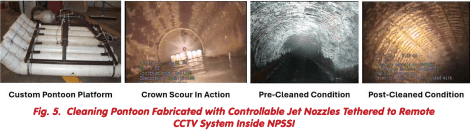
These issues moved the project into Phase 2 for further preparation, inspection, investigations, and assessment using more advanced internal inspection and asset management tools. To accomplish this a pre-cleaning program under Phase 2 was needed. Consequently, the project team retained a subcontractor to design and build a “cleaning platform” using a pontoon and hydraulic and remotely control jetting system that would concentrate the follow-up CCTV inspection in the area of the pipe crown. This cleaning effort and results are shown in Figure 5, and it was, as they say, “a game changer” and provided the specific condition assessment information that the project team needed to assess the entire NPSSI.
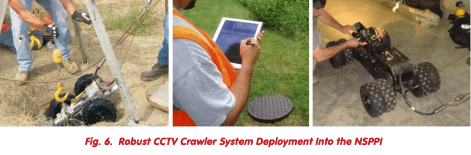
Following this pre-cleaning effort, a CCTV inspection crew was deployed to the NPSSI, and this began a challenging phase of navigating the NPSSI using a robust CCTV inspection platform with steerable and live controls. This was essential, since this was the first time that the NPSSI had been cleaned to a level that would allow unhindered wastewater flow through the high-priority areas. This inspection platform is shown in Figure 6.
Results, Conclusions, and Recommendations for Rehabilitation of the NPSSI:
Finally, these Phase 2 assessment results were evaluated on the basis of risk as the City needed to determine which sections of the NSPPI should be rehabilitated based on both likelihood of failure (LOF) and consequence of failure (COF). There was simply not enough funding to address all red and yellow pipelines and assets.
Once this internal inspection work was completed, the project team developed a systematic approach to creating a scalable scoring process that would have enough granularity in asset scores but still categorize each of the 155 pipe segments into manageable quantities. Given the fact that no assessments of the pipeline were made of the NSPPI below the flow line, it was decided that three scoring categories would be used, assuming that conditions below the flowline would be captured as part of the pre-construction phase. The description and narrative for each of the categories (or buckets as the team referred to them) and the location and quantity within each of the categories are shown in Table A and Figure 7.
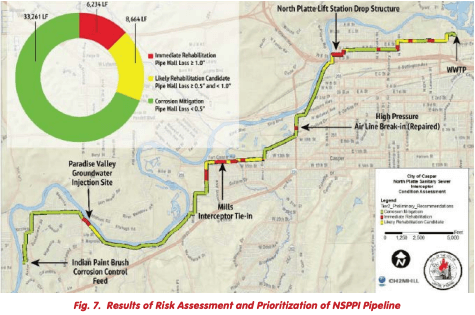
Table A – Results of Phase 2 Risk and Condition Assessment
| Category Description | Color | Pipe Wall Loss | Footage |
| Immediate Rehabilitation | Red | $>1.0″$ | 6,200′ |
| Likely Rehabilitation in Near Future | Yellow | $0.5 – 1.0″$ | 8,700′ |
| No Rehabilitation Required | Green | $<0.5″$ | 33,300′ |
| Total Inventory of NSPPI | 48,200′ |
By developing a risk score and updating the mapped results shown in Figure 7 for each asset of the NPSSI (pipelines, access structures, and cross-connections) the project team then created a full and prioritized list of all NPSSI assets in order of its Aggregated Score (or Asset Grade), recommended reinspection frequency, and planning-level costs as shown in Figure 8.
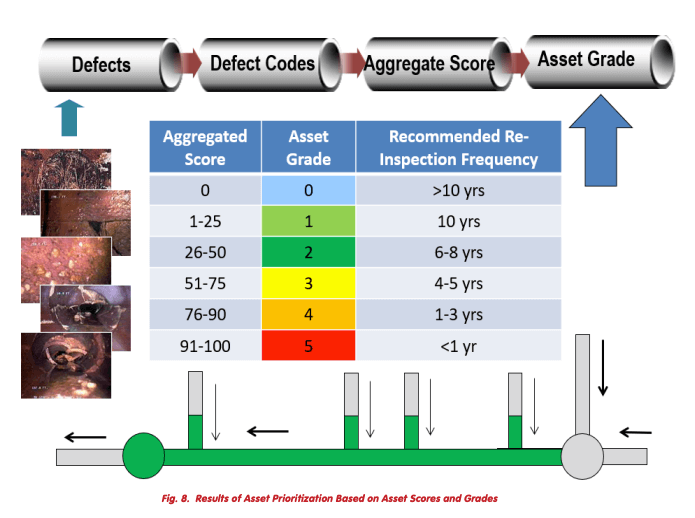
The City also determined that the first major CIP effort would need to be capped at around $7.0 million with the expectation that this initial program would represent the greatest impact to the overall operation of the NPSSI over the design life of the capital improved planned for the future (75-100 years). On that basis the project team finally prepared and submitted for the City’s approval the “NPSSI Asset Management Report” in 2020. That particular report became the basis for the work to come.
Results of the inspections also indicated that a very significant cost savings could be achieved over a 50-year lifecycle by actually implementing two side-by-side programs at the same time. The first was a long-term infrastructure rehabilitation program for those portions of the NPSSI system that required rehabilitation and the second (and parallel) program was the implementation of a corrosion control program that focused on infrastructure for chemical addition to those portions of the NSPPI that would represent lower risk scores and reduce and slow down deterioration of those NPSSI with lower asset grades and scores.
Summary and a Peak Into the Next Phase Fixing the NPSSI With Trenchless Rehab Technologies:
With a final CIP implementation plan and funding in place, the project team moved into the next phase of the project and getting the highest priority sections of the NPSSI rehabilitated for the long-haul. And there were, for sure, several major challenges yet to be managed, including the development of bid-ready plans and specifications that would open up the project to a wide range of renewal pipeline technologies while ensuring that the final outcome of the program would result in a sustainable and reliable pipeline for the next several decades.
Part 2 of this phase of the project will be published in the next edition of BAMI-I in February, 2025. There is broad consensus that the NPSSI rehabilitation project was successful at several levels and shows the importance of well-planned and executed inspection and planning-level work, effective communication and collaboration will all stakeholders, and the use of innovative trenchless technologies to rehabilitate the critical sections of the NPSSI resulted in outcomes beyond expectation.
Part B will show how this happened and why these sections of the NPSSI now show they represent a wastewater conveyance system for the next 75-100 years (and even longer)! As an added note, this project was awarded the Rocky Mountain North American Society of Trenchless Technology (RMNASTT) Project of the Year Award in 2023.
Acknowledgments
We would like to acknowledge Tom Brauer and Krista Johnston of the City of Casper and project team representatives from CEPI and Jacobs, for their contributions to this manuscript. Quite frankly, they are the real reason that this project was a total success including the means and methods developed and implemented to deal with the challenges that are always encountered when rehabilitating buried pipeline assets.
Author: Mark G. Wade, P.E. – BlueWater Solutions Group, Inc
REFERENCES
CH2M HILL and CEPI, Project Report, “North Platte Sanitary Sewer Interceptor Condition Assessment Study”. April 2012.
Snider, K. and Wade, M. 2014. Sanitary Sewer Interceptor Corrosion Modeling and Corrosion Control Pilot Testing at Casper, WY. WEFTEC, New Orleans, LA. September 28, 2014.
ASTM 1216, Standard Practice for Rehabilitation of Existing Pipelines and Conduits by the Inversion and Curing of Resin-Impregnated Tube, 2019.
Jacobs Engineer, Project Plans and Specifications, “North Platte Sanitary Sewer Rehabilitation – City of Casper Public Services Department, Engineering Division, Casper, WY,” February, 2022.