CONSTRUCTION INSPECTION IS PART OF ASSET MANAGEMENT
Competent inspection during pipeline construction is more than a best practice—it’s a smart investment. Ensuring proper installation from the start is critical to the long-term durability, safety, and performance of pipeline infrastructure assets. Identifying issues early helps prevent costly repairs, unexpected outages, and emergency interventions. Pipelines that are properly inspected during construction typically require less maintenance over time, resulting in lower operational costs.
Asset management and proper inspection are tightly interconnected in pipeline construction. For pipelines, this process begins during design and construction, where critical decisions shape long-term outcomes. Inspection ensures these decisions are correctly executed in the field, laying the groundwork for a reliable asset.
According to the American Water Works Association, roughly 16 percent of treated water—about 6 billion gallons—is lost every day, amounting to nearly $3 billion in annual revenue. Even more troubling, most of these leaks remain hidden underground, sometimes surfacing only after considerable damage has occurred. A buried defect can become an expensive liability. This is why reliable construction practices are essential—and why getting installation right the first time can help prevent both leaks and the financial consequences that follow.
Without thorough inspection during installation, undetected errors can become long-term liabilities. Deficiencies such as improper backfilling, poor joint alignment, or inadequate support can lead to pipeline failures years later. These failures not only drive up maintenance costs but also disrupt service and undermine public trust. Construction-phase inspection serves as a critical quality control tool for preventing such outcomes.
Inspect it now, or dig it up later.
Despite the clear value of inspection, a common misconception persists: that it is only necessary within the first 30 days after construction. In practice, inspection should begin before pipe installation, continue throughout construction, and extend well beyond project completion. A post-construction baseline inspection helps document initial conditions. A follow-up inspection after about one year can reveal issues that develop over time, such as deformation or cracking from increased loads, staining from leaky joints, or sagging caused by foundation differential settlement.
While advanced technologies like CCTV and laser profiling are increasingly used for post-installation assessments, they are not foolproof. These tools require skilled, certified operators—and even then, problems can be missed. That’s why independent, qualified inspectors must oversee the process—not only to verify results, but also to catch issues that automated tools may overlook.
Digging up pipe unnecessarily is a waste of resources. A $2 million project escalated into a $35 million lawsuit and a pipe buried 50 feet deep had to be excavated and replaced. In another case, a $20 million pipeline had to be completely removed and rebuilt—doubling the cost. What did these costly failures have in common? No trained inspectors on site.
Do it right or do it twice.
Just as inspection protects the physical integrity of pipeline infrastructure, professional training supports consistency and competence in the field. A new online training course is now available for inspectors involved in water, sewer, culvert, and storm drain projects. The 14-hour course is self-paced and can be accessed at any time from a computer, tablet, or smartphone. It includes downloadable inspection checklists for field use. Participants also receive a copy of Pipeline Installation 2.0 (a $125 value), which serves as the course text and a lasting reference. A certificate of completion and Professional Development Hours (PDHs) are awarded at the end of the course.
Specifications do not cause leaks, but not enforcing the specifications may.
FUNDAMENTAL INFORMATION
New inspectors and new engineers will learn about the basic principles of pipeline installation such as:
- The difference between rigid and flexible pipe construction
- Terminology for buried pipe
- Soil classification for pipelines
- Trench excavation safety
- Compaction methods
- Soil testing
- Methods of joining pipe
Understanding these principles may help the inspector make on-site decisions that contribute to the success of the project, such as:
Rigid versus Flexible Pipe: Rigid pipe (concrete, clay) must be supported underneath and in the haunches. Flexible pipe (steel, plastic, ductile iron) depends on side support. Confusing the two can lead to failures—one contractor mistook a mortar-coated steel pipe for concrete and installed it incorrectly.
Terminology: Terms are not consistent in the industry. For example, one organization refers to bedding as the material under the pipe while another uses bedding to indicate the soil on the sides of the pipe. One may be uncompacted while the other may be compacted. Miscommunication between inspectors and contractors can shorten the life of the pipeline.
Compaction: Cohesive soils need impact or pressure; cohesionless soils need vibration. Soil type also determines the right testing method. Using the correct approach saves time, money, and effort.
Soil Testing: The course explains when to use standard vs. modified Proctor tests, and when to choose sand cone over nuclear density tests—ensuring a reliable installation.
Joining Pipe: Joints are often the weakest point in a pipeline, and improper construction can lead to significant leaks. Even if the pipe itself is designed to last 50 years, poor joint construction can render that durability meaningless. In one case, a 36-inch polyethylene sewer failed because of incorrect joint fusion. This highlights the importance of proper training in heat fusion techniques and the critical role of thorough joint inspection.
Consider one real-world example: a storm drain collapsed with just three feet of backfill over the pipe. The inspector had documented that “the contractor is pushing pipe down to grade with the excavator bucket,” a practice that is prohibited for all pipe materials. The force applied by the bucket compromised the pipe’s structural integrity, leaving it unable to support even minimal loading. This failure could have been avoided with proper training and oversight.
USEFUL FOR NEW AND VETERAN INSPECTORS
The training is designed primarily for new inspectors, but experienced professionals may also benefit from updated guidance on recent innovations in pipeline construction. Topics include:
- Use of uncompacted bedding beneath the pipe
- Application of uncompacted padding above the pipe
- Techniques to prevent soil migration
- Employing composite soil stiffness in unstable trench walls
- A new method for measuring maximum density in cohesionless soils
- Cost-effective use of native soils to create flowable fill
These practices are supported by modern engineering principles, and the course explains the rationale behind each one. Understanding the “why” behind new procedures helps inspectors and contractors adopt them confidently and consistently:
Uncompacted Bedding: Using uncompacted clean gravel or crushed rock as bedding allows the weight of the pipe, its contents, and the overlying backfill to form a stable cradle. This also improves load transfer to the haunch zone and enhances long-term support.
Uncompacted Padding: Avoiding compaction directly above the pipe is a newer practice that helps protect the pipe from damage during backfilling. It also encourages soil arching, which redistributes vertical loads away from the pipe.
Migration: Clean materials like crushed rock or gravel have large void spaces between the particles. Without proper precautions, using these materials can result in surrounding soils migrating into these voids over time, reducing the stability of the embedment and compromising pipe support.
Composite Soil Stiffness: The embedment material supports the pipe, while the trench walls support the embedment. In areas with weaker trench walls, overall support is reduced. To address this, designers now consider both embedment and trench wall soil stiffness together. This concept of composite stiffness may explain why trench width varies along a pipeline. Contractors and inspectors should understand this to avoid misinterpreting it as a design error.
New Maximum Density Test: Proctor-type tests are not suitable for cohesionless soils. ASTM now recommends a vibratory hammer test, which provides more reliable and consistent results when determining the maximum density for these materials.
Native Flowable Fill: Flowable fill offers strong support for buried pipes but can be expensive when supplied from ready-mix plants. An alternative approach is to use native soil excavated from the trench to create a cost-effective flowable fill on site. This method reduces the need for imported materials and disposal of excess soil. The course includes detailed guidance on how to meet construction and inspection requirements for this type of pipe support.
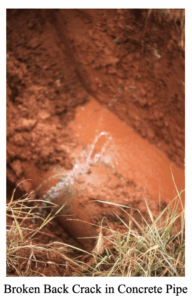
Broken Back Crack in Concrete Pipe
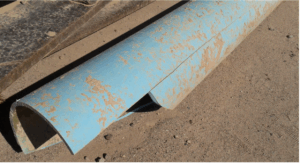
PVC Pipe That was Placed on Rocks
Pipe placed directly on rock have failed due to point loading that creates concentrated stress on the pipe surface. These issues often remain hidden for years before problems emerge. This type of failure is preventable with proper inspection during installation. As one construction supervisor noted, “We continue to have failures… almost always involving rocks rubbing on the pipe over time.”
Do it once and do it right
COURSE SUBSTANCE
The course places strong emphasis on the geotechnical aspects of pipeline construction. It covers key topics such as soil classification, density, compaction, and the appropriate test procedures for each. In addition, the course outlines best practices for unloading, laying, joining, and inspecting pipe systems.
Equally important, it demonstrates how construction inspection supports long-term asset management. Data collected during installation becomes part of the asset’s permanent record, informing maintenance planning, regulatory reporting, and future decisions on repair or replacement. In this way, inspection and asset management reinforce each other throughout the pipeline’s life cycle.
Drawing on the author’s 60 years of experience investigating pipeline failures, the content includes numerous real-world case histories. These examples highlight the importance of following proper procedures and illustrate the costly consequences of inadequate inspection. One participant said:
“I’ve been a heavy/civil construction inspector for over 30 years. I enjoyed this training, learned some things, and was a little disappointed when it ended.”
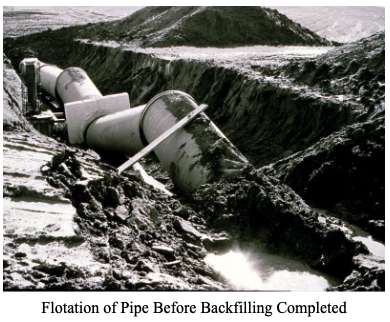
Flotation of Pipe Before Backfilling Completed
SUMMARY
Key benefits of in-depth inspector training include:
- Ensuring the pipe is installed in accordance with specifications
- Eliminating hidden liabilities that may surface later
- Creating records to support long-term maintenance planning
- Providing data for future repairs or replacements
- Supporting regulatory compliance through accurate documentation
- Enabling effective monitoring of pipeline performance
- Identifying exact pipe locations to prevent future construction damage
In-depth construction inspection is a foundational element of asset management, ensuring reliability, controlling risk, and supporting durability throughout the pipeline’s service life.